
Readable without JavaScript
Definitions, worked examples and important limits remain visible before the interactive calculator runs.
Use the calculators to check heat loss, moisture, U-values and project costs. Open the 3D studies to inspect how boilers, HRSGs, kettles and dryers are divided into real equipment zones. Inputs, formulas, limits and downloads are shown on each page.
Each link opens a working calculator, dataset or equipment study.
Calculate heat flow, thermal resistance and saturation margins.
Inspect real equipment zones through manually built 3D and thermal models.
Turn measurements and quote inputs into transparent, reusable project records.
Read the assumptions, download the data and reproduce the arithmetic.
Download the same list as CSV or JSON for a spreadsheet, reference list or internal training note.
| Topic | Question and resource | How it is calculated | What you get |
|---|---|---|---|
| Heat loss | How much heat, energy cost and CO2 can insulation save? | Quick screening model: lumped outside coefficient h = 10 W/m2K | W/m, kW, annual energy, cost, CO2 and payback |
| Moisture | At what temperature can moisture reach saturation? | PsychroLib 2.5.0 saturation-pressure equations | Dew or frost point, surface margin and vapour pressure |
| Walls, roofs & floors | What is the U-value of a layered wall, roof or floor? | Layer thermal resistance with declared conductivity inputs | Layer resistance, total R and U-value |
| Walls, roofs & floors | How do US R-values compare with SI U-values? | US/SI thermal-resistance conversion and climate-zone target lookup | R-US, R-SI, U-SI and target gap |
| Project cost | How many insulation packages does a US attic project require? | Exact package coverage, minimum-order and line-item arithmetic | Required and ordered packages, material and project totals |
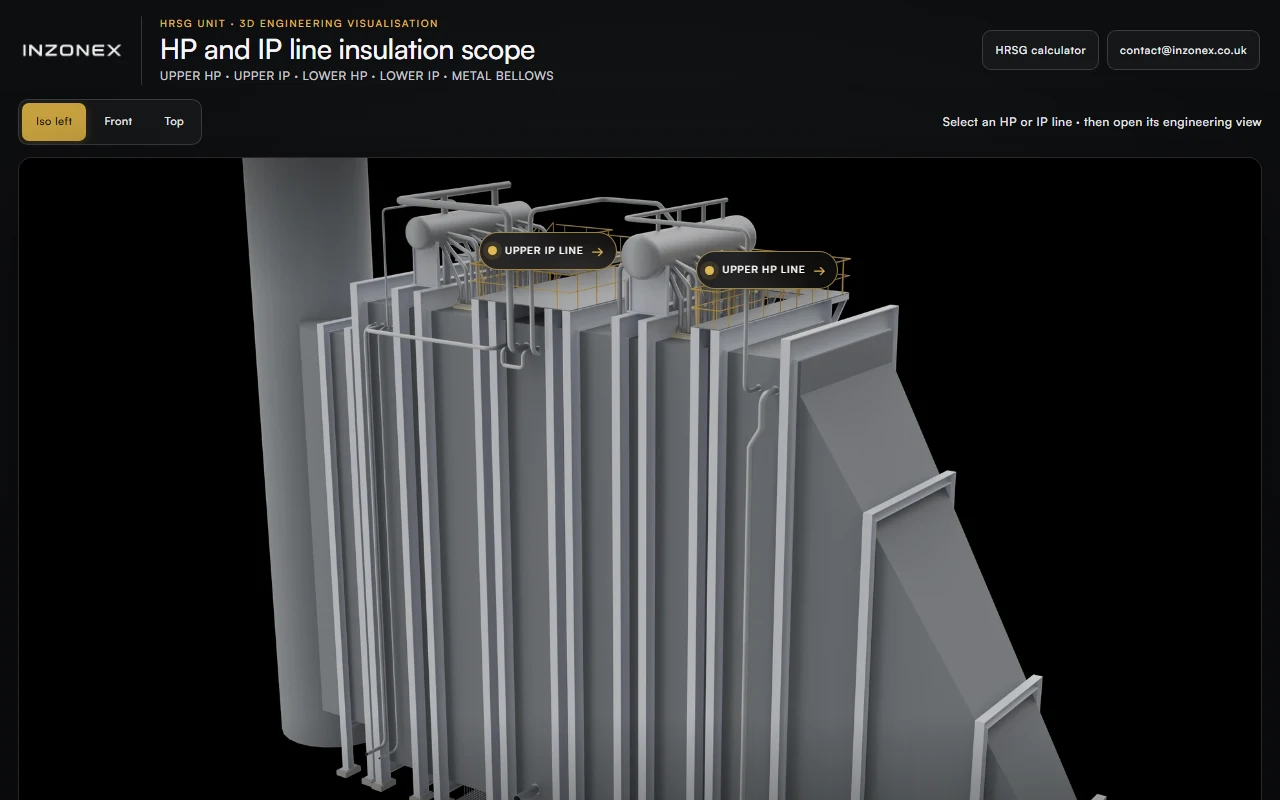
| Power generation | Which HRSG components can be surveyed and insulated? | Field-survey geometry and manually built CAD models | Normal and thermal component views with scope boundaries |
| Power generation | How does retained HRSG heat change plant energy pathways? | Explicit convection, radiation and component geometry | Heat retained, surface temperature, fuel or output pathway |
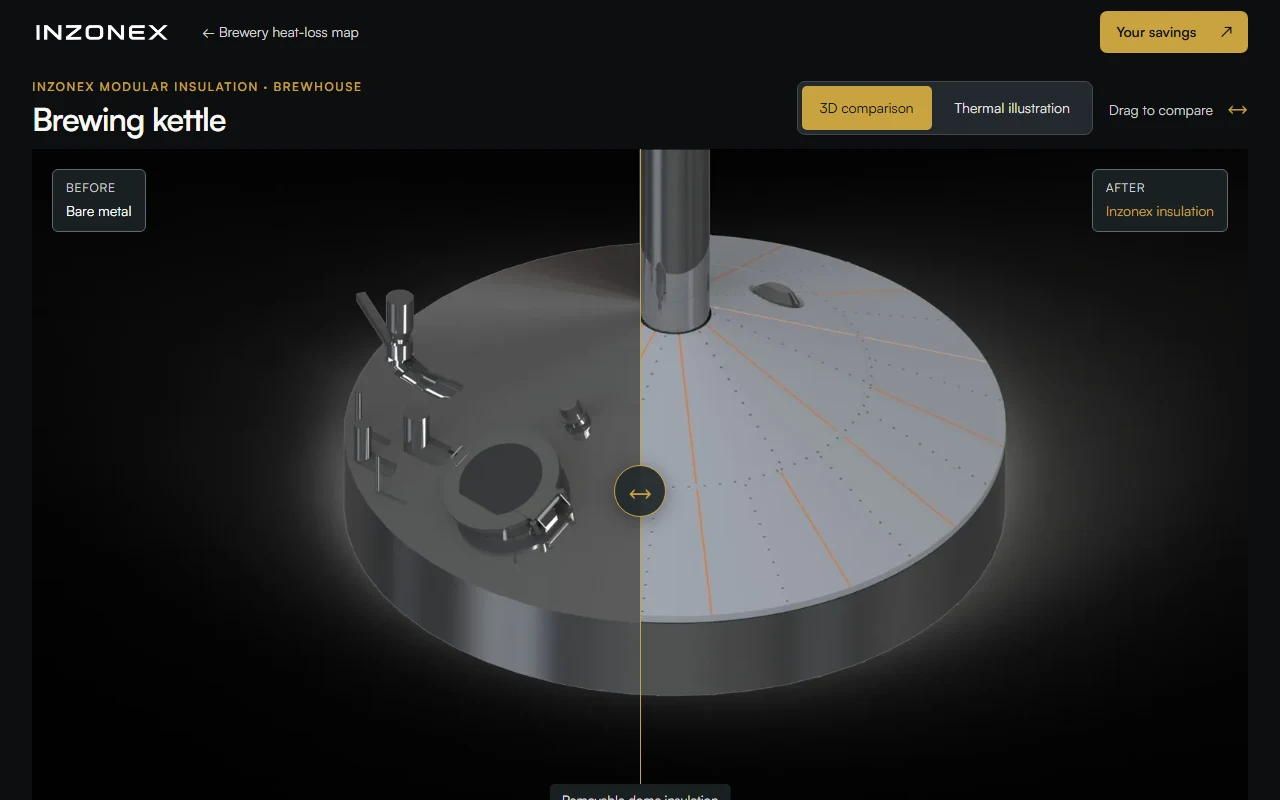
| Brewing | Where does a wort kettle lose heat? | Manually modelled kettle zones with separate area inputs | Zone-level heat loss, savings and surface view |
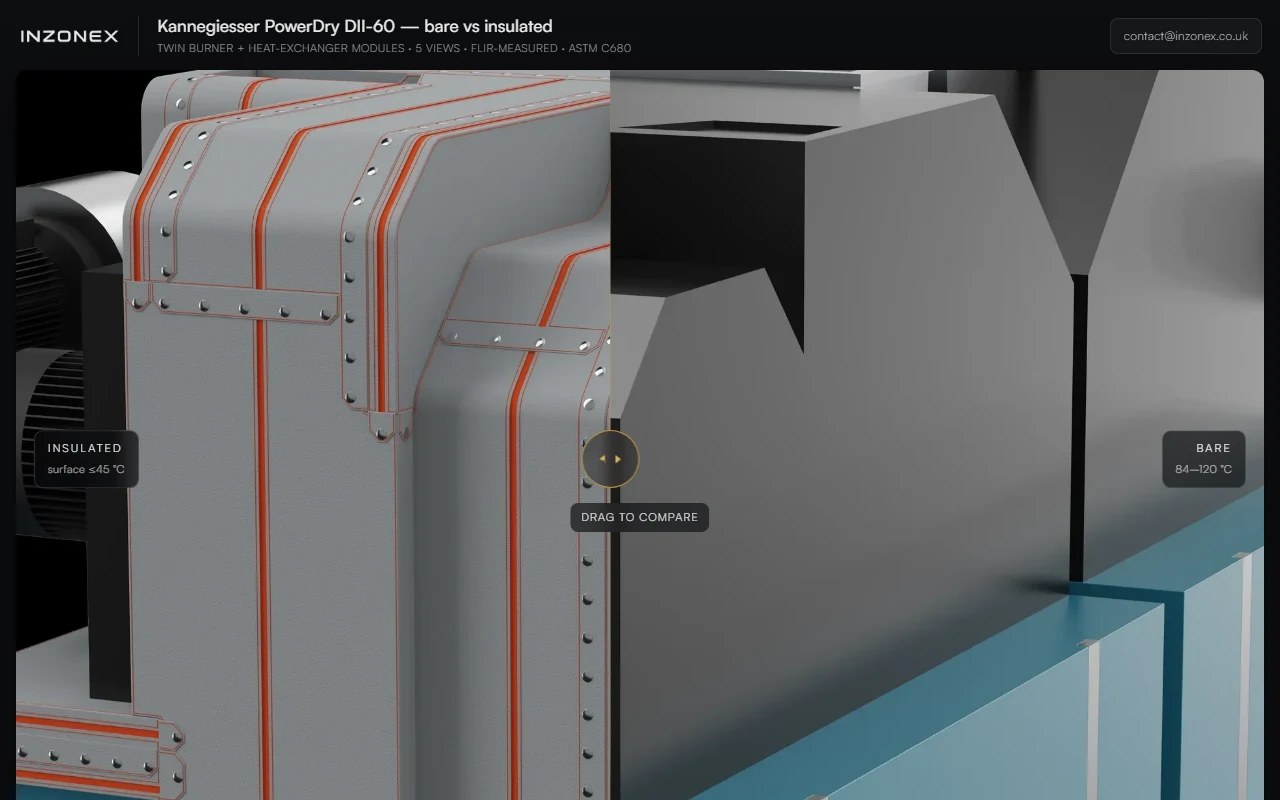
| Industrial laundry | Which dryer modules are practical insulation targets? | Burner and heat-exchanger module geometry | Module-level heat-loss and insulation comparison |
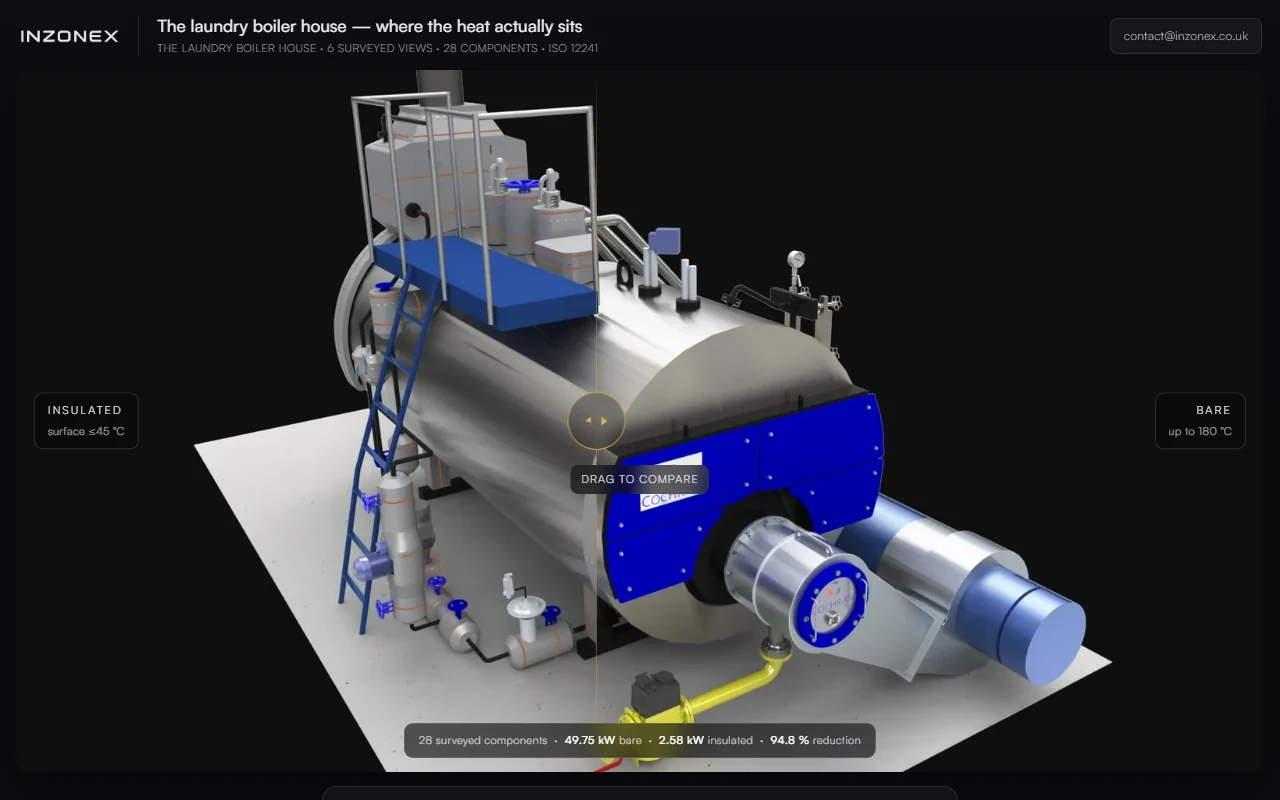
| Steam systems | How is a compact steam boiler surveyed for removable insulation? | Field-surveyed boiler-house geometry and detailed heat model | Equipment scope, heat-loss comparison and project inputs |
This is a free engineering reference library operated by Inzonex. It does not award degrees, licences or accredited qualifications.
Definitions, worked examples and important limits remain visible before the interactive calculator runs.
Each page separates entered measurements, published reference data, calculated results and fictional examples.
Where useful, the page includes CSV, JSON, a chart or a model manifest with a version and reuse terms.
No. It is a public engineering-learning library operated by Inzonex. It provides calculations, datasets and equipment studies, but it does not award degrees, professional licences or accredited qualifications.
No. They support screening, comparison and learning. Final material selection, thickness, safety, compliance and installation decisions require project-specific inputs and engineering review.
Each download states its own licence, version, method and attribution requirements. Check the accompanying reuse file or metadata before republishing a table or chart.
The studies separate equipment zones and calculation boundaries instead of treating an entire boiler, HRSG, kettle or dryer as one generic surface. Their model and evidence limits are stated on the relevant page.