
US insulation · static data + live converter
Insulation R-value chart
Read the climate-zone target first, then convert R/U units or estimate the nominal R-value already in an attic.
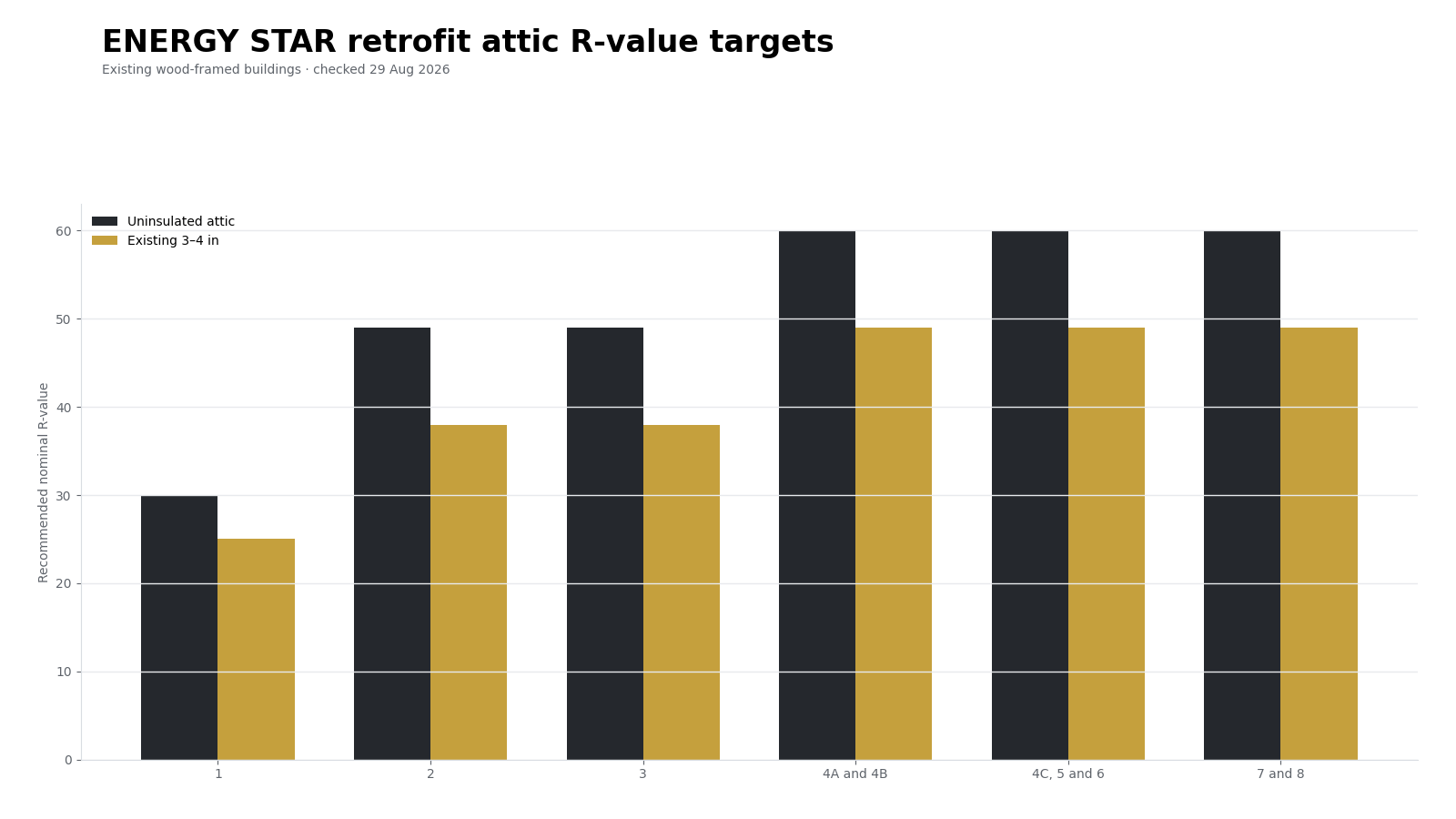
ENERGY STAR's retrofit table lists uninsulated-attic targets of R-30 in zone 1, R-49 in zones 2–3, and R-60 in zones 4A–8. For attics already containing 3–4 inches of insulation, the listed targets are R-25, R-38 or R-49 by zone. The rows apply to existing wood-framed buildings and cite a 2021 IECC basis; they are not a substitute for local code or assembly review.
Convert R and U
One resistance or transmittance value, four equivalent units.
Calculation method
Convert measured depth into an R-value gap
U-SI = 1 / R-SI
existing R-US = measured depth (in) × rough R/in factor
nominal gap = max(0, selected target − existing R-US)
Safety before measurement
Do not disturb suspected vermiculite insulation before appropriate assessment. Identification from appearance is only a rough screen. Air sealing, moisture, electrical hazards, access and local requirements remain separate checks.
Sources checked
- Recommended Home Insulation R-Values — ENERGY STAR / U.S. Environmental Protection Agency. Retrofit recommendations for existing wood-framed buildings; source notes a 2021 IECC basis.
- What to Look For: DIY Checks and Inspections — ENERGY STAR / U.S. Environmental Protection Agency. Depth multipliers for a rough estimate of existing attic insulation R-value and attic safety notes.
- Adding Attic Insulation — ENERGY STAR / U.S. Environmental Protection Agency. General attic-insulation and air-sealing sequence; not a project quotation.
Downloadable data
Download the rows behind the tool
Machine-readable targets, rough depth factors and a dated source list.
| Material | Rough identification | R per inch |
|---|---|---|
| Loose fiberglass | Lightweight yellow, pink or white loose fibers | R-2.5 |
| Loose rock wool | Dense gray or near-white loose fibers, sometimes with black specks | R-2.8 |
| Cellulose | Small gray flat pieces or fibers from newsprint | R-3.7 |
| Vermiculite or perlite | Lightweight granules; do not disturb suspected vermiculite before appropriate assessment | R-2.7 |
| Fiberglass batts | Lightweight yellow, pink or white batts | R-3.2 |
Questions answered
R-value questions
What R-value is recommended for an uninsulated attic?
ENERGY STAR's retrofit table lists R-30 for climate zone 1, R-49 for zones 2 and 3, and R-60 for zones 4A through 8. The table is for existing wood-framed buildings and is not a project-specific code determination.
How do I convert US R-value to metric R-value?
Multiply US R-value by 0.1761101838 to obtain m²·K/W. For example, US R-30 is approximately 5.283 m²·K/W.
How can I estimate the R-value of existing attic insulation?
Multiply measured depth in inches by ENERGY STAR's rough material factor: 2.5 for loose fiberglass, 2.8 for loose rock wool, 3.7 for cellulose, 2.7 for vermiculite or perlite, or 3.2 for fiberglass batts.
Does this chart prove code compliance?
No. It reproduces ENERGY STAR retrofit recommendations and a transparent conversion method. Assemblies, local codes, moisture, air sealing, installation quality and product documentation still need project-specific review.