
Walls, roofs and floors · UK product data
U-value calculator
From individual layers to a whole-assembly U-value. Compare five documented Kingspan, Celotex / SOPRATHERM, Recticel and ROCKWOOL products without treating them as interchangeable specifications.
Element surfaces and correction
The element label sets only the displayed surface-resistance pair. An exposed floor is not a ground-coupled floor calculation. Use Custom when the boundary conditions differ.
Assembly result
Effective R m²K/W
Layer R before bridge correction · m²K/W
Illustrative starting layers, not an approved specification. One repeating timber layer only. No metal frames, ground-coupled floors or automatic fixing/gap corrections. A U-value alone does not establish compliance.
Saved comparisons
| Assembly | U (W/m²K) | Actions |
|---|
Calculation ledger
| Layer | Thickness (mm) | λ (W/mK) | Calculated R (m²K/W) | Declared R (m²K/W) |
|---|
Fixed R has no implied thickness or conductivity. All intermediate calculations retain full precision; display values are rounded.
Insulation property dataset
Checked · Version 2026-08-29.1 · Selected UK product literature, not live stock or a complete manufacturer catalogue.
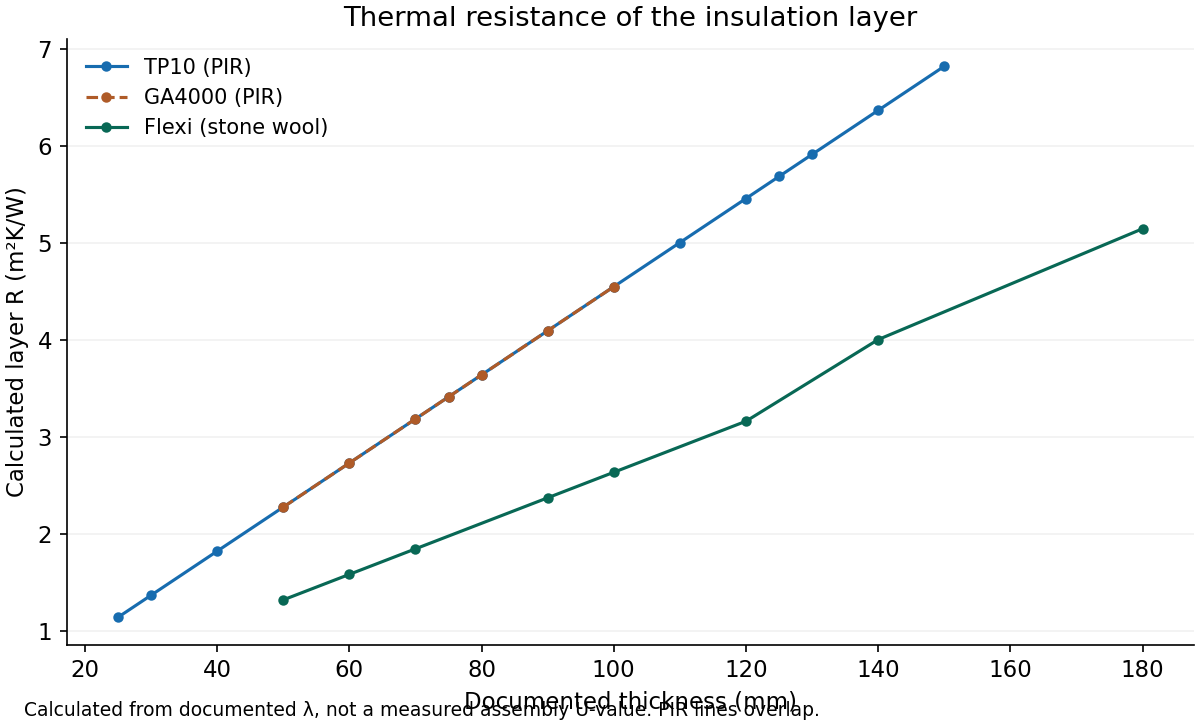
Five products for different applications
Thermapitch TP10. PIR data for pitched roofs; conductivity 0.022 W/mK.
GA4000. PIR now sold as SOPRATHERM, previously Celotex. The technical sheet controls the rows, including 100 mm declared R 4.50.
Eurowall+. PIR for full-fill masonry cavity walls; 75 mm is available on request.
Kooltherm K108. Phenolic partial-fill cavity-wall board. Current UK DoP issue 003 declares λD 0.019 W/mK.
Flexi. Stone wool variants at 50–120 mm use 0.038 W/mK; 140 and 180 mm use 0.035.
Declared R is kept alongside d/λ. The material type and stated application show where each row came from; they do not mean the products are interchangeable.
All 50 source-linked property rows
| Product | Class | mm | λ (W/mK) | Declared R | Calculated R | References |
|---|---|---|---|---|---|---|
| Kingspan Thermapitch TP10 | PIR rigid board | 25 | 0.022 | 1.10 | 1.136 | Property · range/use |
| Kingspan Thermapitch TP10 | PIR rigid board | 30 | 0.022 | 1.35 | 1.364 | Property · range/use |
| Kingspan Thermapitch TP10 | PIR rigid board | 40 | 0.022 | 1.80 | 1.818 | Property · range/use |
| Kingspan Thermapitch TP10 | PIR rigid board | 50 | 0.022 | 2.25 | 2.273 | Property · range/use |
| Kingspan Thermapitch TP10 | PIR rigid board | 60 | 0.022 | 2.70 | 2.727 | Property · range/use |
| Kingspan Thermapitch TP10 | PIR rigid board | 70 | 0.022 | 3.15 | 3.182 | Property · range/use |
| Kingspan Thermapitch TP10 | PIR rigid board | 75 | 0.022 | 3.40 | 3.409 | Property · range/use |
| Kingspan Thermapitch TP10 | PIR rigid board | 80 | 0.022 | 3.60 | 3.636 | Property · range/use |
| Kingspan Thermapitch TP10 | PIR rigid board | 90 | 0.022 | 4.05 | 4.091 | Property · range/use |
| Kingspan Thermapitch TP10 | PIR rigid board | 100 | 0.022 | 4.50 | 4.545 | Property · range/use |
| Kingspan Thermapitch TP10 | PIR rigid board | 110 | 0.022 | 5.00 | 5.000 | Property · range/use |
| Kingspan Thermapitch TP10 | PIR rigid board | 120 | 0.022 | 5.45 | 5.455 | Property · range/use |
| Kingspan Thermapitch TP10 | PIR rigid board | 125 | 0.022 | 5.65 | 5.682 | Property · range/use |
| Kingspan Thermapitch TP10 | PIR rigid board | 130 | 0.022 | 5.90 | 5.909 | Property · range/use |
| Kingspan Thermapitch TP10 | PIR rigid board | 140 | 0.022 | 6.35 | 6.364 | Property · range/use |
| Kingspan Thermapitch TP10 | PIR rigid board | 150 | 0.022 | 6.80 | 6.818 | Property · range/use |
| SOPRATHERM GA4000 (previously Celotex) | PIR rigid board | 50 | 0.022 | 2.25 | 2.273 | Property · range/use |
| SOPRATHERM GA4000 (previously Celotex) | PIR rigid board | 60 | 0.022 | 2.70 | 2.727 | Property · range/use |
| SOPRATHERM GA4000 (previously Celotex) | PIR rigid board | 70 | 0.022 | 3.15 | 3.182 | Property · range/use |
| SOPRATHERM GA4000 (previously Celotex) | PIR rigid board | 75 | 0.022 | 3.40 | 3.409 | Property · range/use |
| SOPRATHERM GA4000 (previously Celotex) | PIR rigid board | 80 | 0.022 | 3.60 | 3.636 | Property · range/use |
| SOPRATHERM GA4000 (previously Celotex) | PIR rigid board | 90 | 0.022 | 4.05 | 4.091 | Property · range/use |
| SOPRATHERM GA4000 (previously Celotex) | PIR rigid board | 100 | 0.022 | 4.50 | 4.545 | Property · range/use |
| Recticel Eurowall+ | PIR rigid board | 75 | 0.022 | 3.40 | 3.409 | Property · range/use |
| Recticel Eurowall+ | PIR rigid board | 90 | 0.022 | 4.05 | 4.091 | Property · range/use |
| Recticel Eurowall+ | PIR rigid board | 115 | 0.022 | 5.20 | 5.227 | Property · range/use |
| Recticel Eurowall+ | PIR rigid board | 140 | 0.022 | 6.35 | 6.364 | Property · range/use |
| Kingspan Kooltherm K108 | Phenolic rigid board | 25 | 0.019 | 1.30 | 1.316 | Property · range/use |
| Kingspan Kooltherm K108 | Phenolic rigid board | 30 | 0.019 | 1.55 | 1.579 | Property · range/use |
| Kingspan Kooltherm K108 | Phenolic rigid board | 40 | 0.019 | 2.10 | 2.105 | Property · range/use |
| Kingspan Kooltherm K108 | Phenolic rigid board | 50 | 0.019 | 2.60 | 2.632 | Property · range/use |
| Kingspan Kooltherm K108 | Phenolic rigid board | 60 | 0.019 | 3.15 | 3.158 | Property · range/use |
| Kingspan Kooltherm K108 | Phenolic rigid board | 70 | 0.019 | 3.65 | 3.684 | Property · range/use |
| Kingspan Kooltherm K108 | Phenolic rigid board | 75 | 0.019 | 3.90 | 3.947 | Property · range/use |
| Kingspan Kooltherm K108 | Phenolic rigid board | 80 | 0.019 | 4.20 | 4.211 | Property · range/use |
| Kingspan Kooltherm K108 | Phenolic rigid board | 90 | 0.019 | 4.70 | 4.737 | Property · range/use |
| Kingspan Kooltherm K108 | Phenolic rigid board | 100 | 0.019 | 5.25 | 5.263 | Property · range/use |
| Kingspan Kooltherm K108 | Phenolic rigid board | 110 | 0.019 | 5.75 | 5.789 | Property · range/use |
| Kingspan Kooltherm K108 | Phenolic rigid board | 120 | 0.019 | 6.30 | 6.316 | Property · range/use |
| Kingspan Kooltherm K108 | Phenolic rigid board | 130 | 0.019 | 6.80 | 6.842 | Property · range/use |
| Kingspan Kooltherm K108 | Phenolic rigid board | 140 | 0.019 | 7.35 | 7.368 | Property · range/use |
| Kingspan Kooltherm K108 | Phenolic rigid board | 150 | 0.019 | 7.85 | 7.895 | Property · range/use |
| ROCKWOOL Flexi | Stone wool slab | 50 | 0.038 | 1.30 | 1.316 | Property · range/use |
| ROCKWOOL Flexi | Stone wool slab | 60 | 0.038 | 1.55 | 1.579 | Property · range/use |
| ROCKWOOL Flexi | Stone wool slab | 70 | 0.038 | 1.80 | 1.842 | Property · range/use |
| ROCKWOOL Flexi | Stone wool slab | 90 | 0.038 | 2.35 | 2.368 | Property · range/use |
| ROCKWOOL Flexi | Stone wool slab | 100 | 0.038 | 2.60 | 2.632 | Property · range/use |
| ROCKWOOL Flexi | Stone wool slab | 120 | 0.038 | 3.15 | 3.158 | Property · range/use |
| ROCKWOOL Flexi | Stone wool slab | 140 | 0.035 | 4.00 | 4.000 | Property · range/use |
| ROCKWOOL Flexi | Stone wool slab | 180 | 0.035 | 5.10 | 5.143 | Property · range/use |
Original calculations and selection: CC BY 4.0, attribute Inzonex and link this page. Manufacturer property facts remain attributed to their sources; no rights are granted over manufacturer documents, images or trademarks. Not a manufacturer-endorsed calculator.
How the U-value is calculated
1. Resistance in series
R_total = Rsi + ΣR_layer + Rse
U = 1 / R_total + ΔU
Thickness is entered in millimetres and converted to metres. A known-R layer accepts a separately established resistance, not a guessed cavity thickness. Surface presets use 0.10, 0.13 or 0.17 inside and 0.04 outside for the identified exposed-air cases. Other conditions need appropriate inputs.
The browser calculation is checked against the open-source ht plane-conduction reference. This is a building-layer calculation, separate from the industrial pipe tool's lumped heat-transfer coefficient.
2. One repeating timber bridge
R_lower = Rsi + ΣR_equivalent + Rse
R_effective = (R_upper + R_lower) / 2
The timber fraction is the fraction of this layer's area occupied by timber, not the fraction of the whole building. For the bridged layer, R_equivalent = 1 / [(1−f)/R_layer + f/R_bridge]. The tool stops above an upper/lower ratio of 1.5. It does not model metal framing, crossing bridges or junction ψ-values.
Both worked presets reproduce SEAI's Irish roof examples. The rafter case has R limits about 6.36 / 5.78; the ceiling case about 6.438 / 6.221, with an explicit 0.0014 W/m²K loft-hatch correction. These are examples, not UK regulatory defaults.
What this result does not decide
Actual moisture, temperature, workmanship, fixings, ventilation and junctions can change performance. This tool does not select a regulatory target, assess condensation or fire safety, verify a product's application or predict annual bills. Ground-coupled and suspended ground-floor calculations require their own geometry and boundary methods. The outside surface setting is editable because sheltered and ventilated conditions differ.
Sources and method references
- Kingspan Thermapitch TP10 GB brochure, page 5
- SOPRATHERM GA4000 technical data sheet TDS-UK-INSUK0025.a/EN
- Soprema: GA4000, previously Celotex
- ROCKWOOL Flexi technical sheet, November 2025, page 3
- ROCKWOOL Flexi UK listed product variants
- Kingspan Kooltherm K108 UK Declaration of Performance 1000.UKDoP.K108.003
- Kingspan Kooltherm K108 Cavity Board UK product page
- Recticel Eurowall+ UK technical datasheet 6VICBX7DDFHZ 230703
- Recticel Eurowall+ UK product specifications
- SEAI DEAP guidance, pages 76-79: worked roof examples
- UK government moisture research, modelling surfaces, page 12
- Santos et al., Energies 2020, section 2.1.1: combined method and limits
- ht conduction library: k_to_R
Questions about the calculation
Is insulation R-value the same as a wall or roof U-value?
No. R describes resistance: a larger R means less heat passes through a layer. U describes heat flow through the whole assembly per square metre and degree of temperature difference: a smaller U means less heat transfer. Surface resistances and repeating bridges can change the assembly result.
Can I use Kingspan, Celotex, Recticel or ROCKWOOL products here?
The presets contain documented thicknesses and thermal properties for Kingspan TP10 and K108, SOPRATHERM GA4000 (previously Celotex), Recticel Eurowall+ and ROCKWOOL Flexi. Selecting a preset is not approval for its use in a particular construction. Check the named application, current product documentation, installation requirements and available sizes.
Which element type should I select?
Choose roof or upward heat flow for an exposed element with heat flowing upward, wall or horizontal heat flow for a vertical element, and exposed floor or downward heat flow for an upper floor over outside air or another exposed condition. These labels only set the visible Rsi and Rse surface values. Ground-coupled floors, sheltered surfaces and other boundary conditions need an appropriate separate method or custom values.
Does this calculation prove Building Regulations compliance?
No. This is a transparent comparison of the layers you enter, not a certified design calculation. Ground floors, metal frames, windows, junctions, moisture and fire performance need other assessments. Fixings, gaps and other corrections are not calculated automatically. Have the complete build-up checked for its actual location and use.
Why can calculated R differ from the manufacturer table?
The layer calculation uses thickness in metres divided by the documented conductivity without rounding intermediate values. Declared R may be rounded down. For example, 100 mm divided by 0.022 gives about 4.545 m²K/W, while the TP10 and GA4000 sheets list 4.50. Both values are retained in the downloadable table.
Product-specific calculators
Brand U-value calculators
Start with a filtered manufacturer dataset, then add the rest of the assembly. Each page keeps the stated application and source references visible.
Related calculations
Industrial pipe insulation · Insulation materials and applications · Heat-loss calculator workbench