
ROCKWOOL Flexi · 8 documented thickness rows
ROCKWOOL U-value calculator
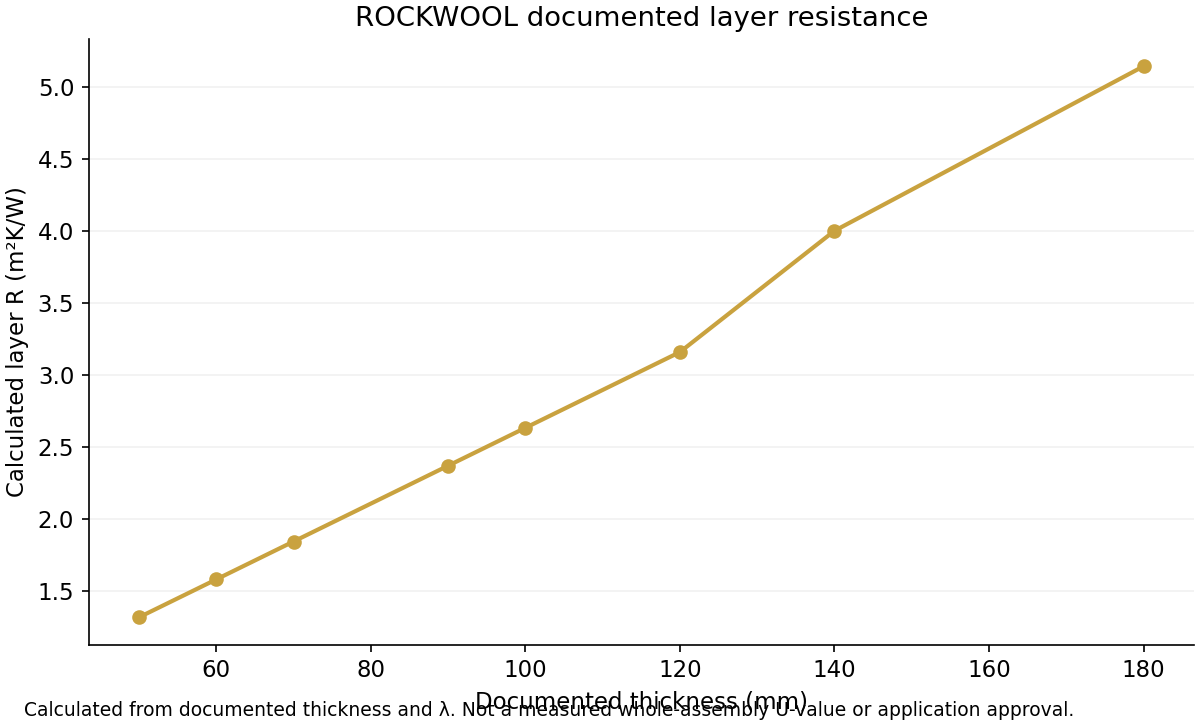
Model a wall, roof or suspended-floor layer using the exact ROCKWOOL Flexi thickness and conductivity rows in current UK literature. The tool preserves the documented conductivity change at 140 and 180 mm instead of applying one value to every thickness.
Element surfaces and correction
The element label sets only the displayed surface-resistance pair. An exposed floor is not a ground-coupled floor calculation. Use Custom when the boundary conditions differ.
Assembly result
Effective R m²K/W
Layer R before bridge correction · m²K/W
Illustrative starting layers, not an approved specification. One repeating timber layer only. No metal frames, ground-coupled floors or automatic fixing/gap corrections. A U-value alone does not establish compliance.
Saved comparisons
| Assembly | U (W/m²K) | Actions |
|---|
Calculation ledger
| Layer | Thickness (mm) | λ (W/mK) | Calculated R (m²K/W) | Declared R (m²K/W) |
|---|
Fixed R has no implied thickness or conductivity. All intermediate calculations retain full precision; display values are rounded.
Source-linked comparison
ROCKWOOL product data
Select a listed Flexi thickness, add the remaining construction layers and, where relevant, model one repeating timber path. The result is a transparent comparison, not approval for a wall, roof or floor design.
Checked · Version 2026-08-29.1 · Selected UK product literature, not live stock or a complete manufacturer catalogue.
How to use the product rows
- Eight documented thicknesses cover 50, 60, 70, 90, 100, 120, 140 and 180 mm.
- Rows from 50 to 120 mm use 0.038 W/mK; 140 and 180 mm use 0.035 W/mK.
- Unlisted thicknesses are not interpolated and the repeating-bridge model supports one timber layer only.
Manufacturer property facts remain attributed to their linked sources. Inzonex supplies the selection, calculation, chart and reusable exports.
All 8 source-linked rows
| Product | Documented use | mm | λ (W/mK) | Declared R | Calculated R | References |
|---|---|---|---|---|---|---|
| ROCKWOOL Flexi | Roofs, timber and metal stud walls, and suspended floors | 50 | 0.038 | 1.30 | 1.316 | Property · range/use |
| ROCKWOOL Flexi | Roofs, timber and metal stud walls, and suspended floors | 60 | 0.038 | 1.55 | 1.579 | Property · range/use |
| ROCKWOOL Flexi | Roofs, timber and metal stud walls, and suspended floors | 70 | 0.038 | 1.80 | 1.842 | Property · range/use |
| ROCKWOOL Flexi | Roofs, timber and metal stud walls, and suspended floors | 90 | 0.038 | 2.35 | 2.368 | Property · range/use |
| ROCKWOOL Flexi | Roofs, timber and metal stud walls, and suspended floors | 100 | 0.038 | 2.60 | 2.632 | Property · range/use |
| ROCKWOOL Flexi | Roofs, timber and metal stud walls, and suspended floors | 120 | 0.038 | 3.15 | 3.158 | Property · range/use |
| ROCKWOOL Flexi | Roofs, timber and metal stud walls, and suspended floors | 140 | 0.035 | 4.00 | 4.000 | Property · range/use |
| ROCKWOOL Flexi | Roofs, timber and metal stud walls, and suspended floors | 180 | 0.035 | 5.10 | 5.143 | Property · range/use |
How the U-value is calculated
1. Resistance in series
R_total = Rsi + ΣR_layer + Rse
U = 1 / R_total + ΔU
Thickness is entered in millimetres and converted to metres. A known-R layer accepts a separately established resistance, not a guessed cavity thickness. Surface presets use 0.10, 0.13 or 0.17 inside and 0.04 outside for the identified exposed-air cases. Other conditions need appropriate inputs.
The browser calculation is checked against the open-source ht plane-conduction reference. This is a building-layer calculation, separate from the industrial pipe tool's lumped heat-transfer coefficient.
2. One repeating timber bridge
R_lower = Rsi + ΣR_equivalent + Rse
R_effective = (R_upper + R_lower) / 2
The timber fraction is the fraction of this layer's area occupied by timber, not the fraction of the whole building. For the bridged layer, R_equivalent = 1 / [(1−f)/R_layer + f/R_bridge]. The tool stops above an upper/lower ratio of 1.5. It does not model metal framing, crossing bridges or junction ψ-values.
Both worked presets reproduce SEAI's Irish roof examples. The rafter case has R limits about 6.36 / 5.78; the ceiling case about 6.438 / 6.221, with an explicit 0.0014 W/m²K loft-hatch correction. These are examples, not UK regulatory defaults.
What this result does not decide
Actual moisture, temperature, workmanship, fixings, ventilation and junctions can change performance. This tool does not select a regulatory target, assess condensation or fire safety, verify a product's application or predict annual bills. Ground-coupled and suspended ground-floor calculations require their own geometry and boundary methods. The outside surface setting is editable because sheltered and ventilated conditions differ.
Sources and method references
- Kingspan Thermapitch TP10 GB brochure, page 5
- SOPRATHERM GA4000 technical data sheet TDS-UK-INSUK0025.a/EN
- Soprema: GA4000, previously Celotex
- ROCKWOOL Flexi technical sheet, November 2025, page 3
- ROCKWOOL Flexi UK listed product variants
- Kingspan Kooltherm K108 UK Declaration of Performance 1000.UKDoP.K108.003
- Kingspan Kooltherm K108 Cavity Board UK product page
- Recticel Eurowall+ UK technical datasheet 6VICBX7DDFHZ 230703
- Recticel Eurowall+ UK product specifications
- SEAI DEAP guidance, pages 76-79: worked roof examples
- UK government moisture research, modelling surfaces, page 12
- Santos et al., Energies 2020, section 2.1.1: combined method and limits
- ht conduction library: k_to_R
ROCKWOOL U-value questions
Which ROCKWOOL Flexi thicknesses are included?
The current dataset contains 50, 60, 70, 90, 100, 120, 140 and 180 mm source-linked variants. It is a selected UK dataset, not a live stock list.
Why does the conductivity change for thicker Flexi products?
The linked technical sheet gives 0.038 W/mK for the 50-120 mm variants and 0.035 W/mK for 140 and 180 mm. The calculator applies the documented value for the selected row and does not interpolate between products.
Can the calculator include timber bridging?
Yes. One material layer can include a repeating timber fraction and timber conductivity. The result uses upper and lower resistance limits and stops when their ratio exceeds the tool's stated applicability limit.
Is the result a ROCKWOOL design or compliance certificate?
No. This is an independent Inzonex calculation with attributed source data. It excludes many project details, is not endorsed by ROCKWOOL and does not establish condensation, fire or regulatory compliance.