
Dew point calculator
Air temperature, humidity and the temperature where moisture reaches saturation. Add a surface temperature to compare a cold pipe, window or wall.
Range: -40 to 60 °C / -40 to 140 °F
Range: 1 to 100%
RH is referenced to liquid water at this air temperature.
Measured or calculated separately. -80 to 80 °C / -112 to 176 °F.
Liquid-water saturation threshold at the entered humidity.
Surface is at or below the dew point.
The comparison does not guarantee a dry surface or predict how much moisture accumulates.
From humidity to a surface margin
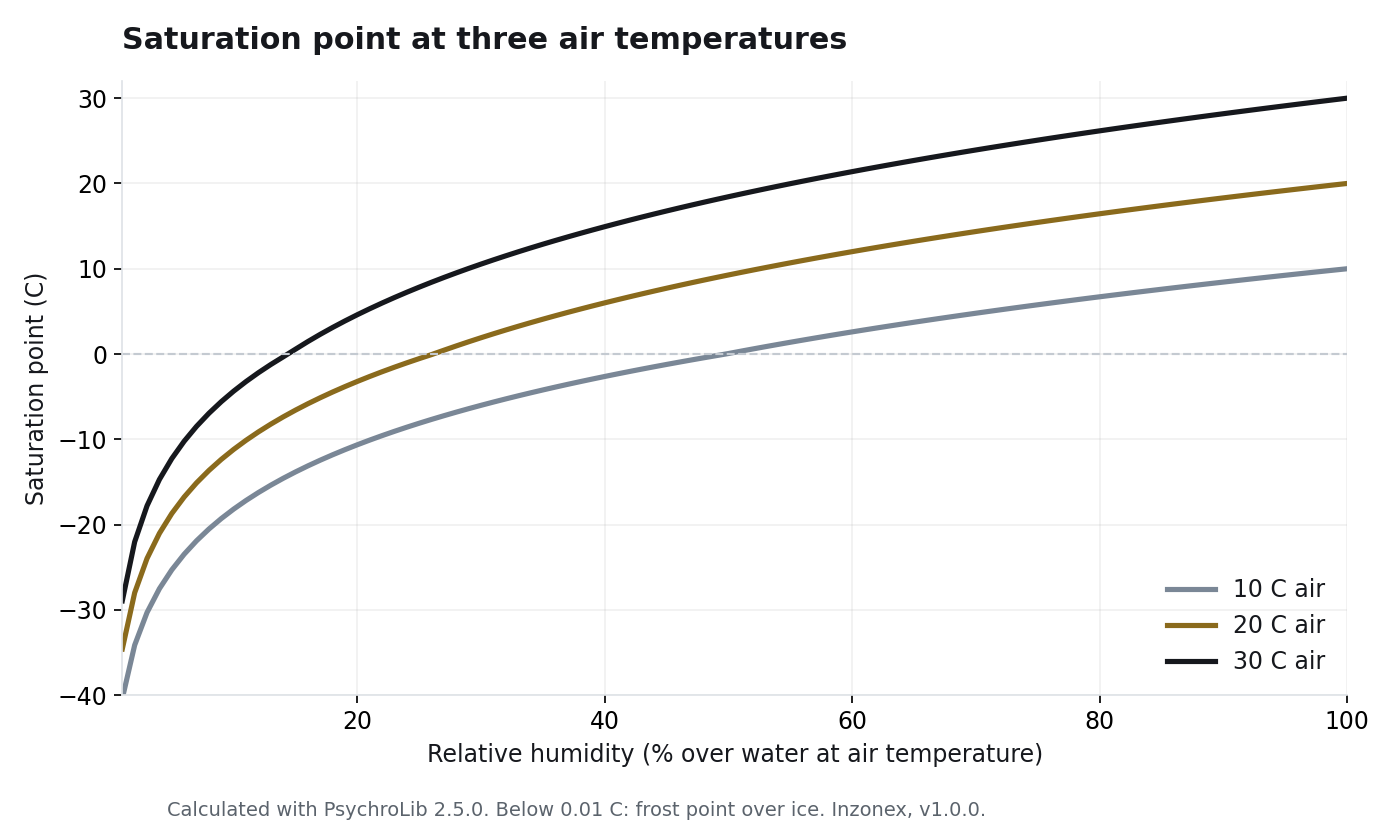
Relative humidity compares the water-vapour pressure in air with saturation at the air temperature. A cooler surface can reach saturation even when the room is not at 100% RH.
vapour pressure = RH / 100 × saturation pressure at air temperature
surface margin = surface temperature − saturation point
PsychroLib inverts its ASHRAE saturation-pressure equations to find the temperature at that vapour pressure. This is a saturation calculation, not a measurement of water deposition.
The phase matters
The library uses saturation over ice at or below the triple-point boundary of 0.01 °C and over liquid water above it. The result is labelled frost point on the ice branch and dew point on the water branch. Below-freezing liquid-water dew point is a different value, not returned by this tool.
When air is at or below 0.01 °C, the entered RH must be referenced to ice. Many instruments report RH relative to water even below freezing: check the instrument convention before entering cold-air data.
A reference grid you can reuse
420 calculated states: air from -40 to 60 °C in 5-degree steps, and RH from 5% to 100% in 5-point steps. Each row includes the RH reference, output phase and water-vapour pressure.
This is a model-generated reference grid, not field measurements. The JSON includes a field dictionary, method version and limitations. A useful reference for a teaching exercise, a psychrometric spreadsheet or a clearly attributed chart.
Inzonex calculated grid/chart v1.0.0: CC BY 4.0. PsychroLib: separate MIT licence. Original ASHRAE equation attribution retained.
Questions about the calculation
What is the difference between dew point and relative humidity?
Relative humidity is a percentage of saturation at the current air temperature. Dew point is the temperature at which the same water-vapour pressure reaches saturation over liquid water. Cooling air raises its relative humidity even if no moisture is added.
Does this calculator return dew point or frost point below freezing?
It follows the phase convention in PsychroLib 2.5.0: saturation over ice at or below 0.01 C, and over liquid water above it. A below-freezing result is labelled frost point, not liquid-water dew point. Below-freezing liquid-water dew point is a different, physically meaningful value and is not calculated here. For cold air, input RH must also be referenced to ice; check your instrument.
Will a surface below the dew point get wet?
The temperature comparison indicates potential condensation, or ice deposition in frost-point mode. It does not model how much moisture deposits or how quickly. Air movement, surface conditions, vapour transport and measurement uncertainty still matter. A positive margin is not a guarantee against moisture problems.
Can this calculate insulation thickness or mould risk?
No. It compares a measured or separately calculated surface temperature with the saturation point. It does not model heat flow through insulation, transient temperatures, vapour barriers, mould growth or a safe thickness. The separate heat-loss calculator has its own screening assumptions.
Method and sources
- PsychroLib API reference: relative humidity, vapour pressure and inverse saturation calculation based on ASHRAE Handbook Fundamentals (2017), chapter 1.
- PsychroLib 2.5.0, pinned source revision. Unmodified JavaScript implementation; MIT licence.
- Vaisala: choosing humidity measurements, including the distinction between dew point and frost point.
Limits used here: air -40 to 60 °C, RH 1–100%, optional surface -80 to 80 °C. Zero RH has no finite saturation temperature and is not accepted. Temperature and RH alone do not establish moisture safety, insulation design or sensor accuracy.
Prepared by Inzonex. Calculation and dataset version 1.0.0. No claimed independent instrument validation or field test.