
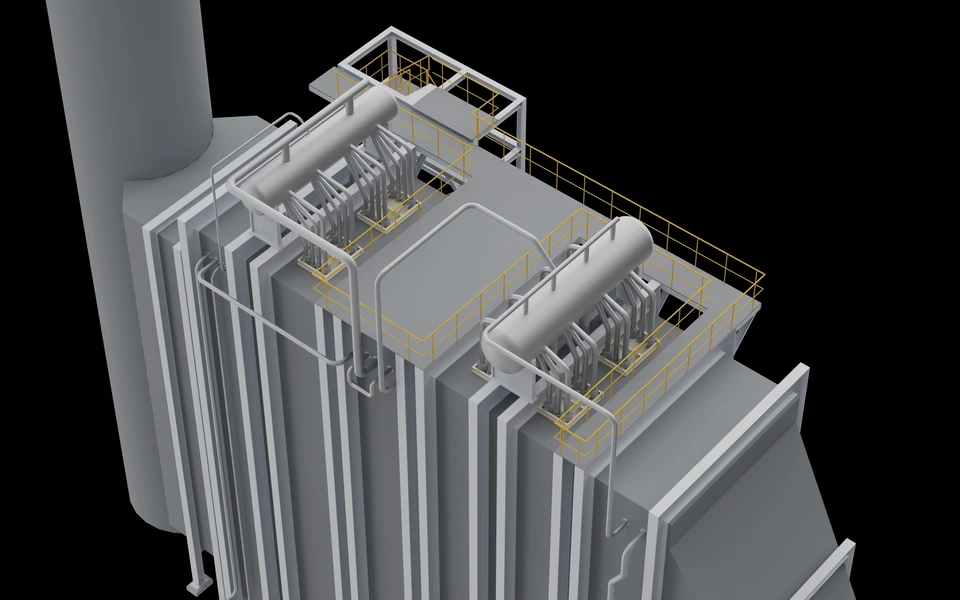
Use engineering names, not visual guesses
A 3D render can show location and fit, but the calculation boundary must follow the equipment. A corrugated metal expansion joint is not a fabric joint and is not a generic “penetration”. Its pitch, convolution depth and developed metal area affect heat transfer, while an adjoining support flange is a separate flat surface.
| Visible object | Engineering name | Calculation boundary |
|---|---|---|
| Horizontal upper vessel | HP or IP steam drum | Equipment context; include only if its own surface is in scope |
| Corrugated flexible section | Metal bellows | Corrugated geometry, temperature and quantity |
| Flat ring above the bellows | Support flange | Flat area; calculated with the metal bellows when both are selected |
| Lower repeated lines | Lower HP or IP line | Its own geometry, temperature and quantity |
| Zip, studs and split flap | Removable module fastening detail | Access design; not a second heat-saving component |
From one element to the plant result
- Calculate the element. Use surface temperature, projected or developed area, ambient, wind, emissivity and the selected insulation build-up.
- Build the selected scope. Multiply only by the verified count for that same geometry and duty; do not apply one bellows value to every HRSG fitting.
- Choose one operating case. Compare either less fuel at the same electrical export or additional steam-cycle output when power is constrained.
- Add commercial values last. The operator enters its energy rate and quoted installed cost. Until then the output stays in engineering units and payback remains blank.
Worked component boundary: support flange with metal bellows
This Upper HP reference case combines the flat support flange with the corrugated metal bellows directly below it. It is a starting case, not a universal value; temperature and quantity remain editable.
| Component | Support flange with metal bellows |
| Line context | Upper HP line support |
| Reference temperature | 460 °C |
| Corrugation inputs | 45 mm pitch · 18 mm depth |
| Projected area | 1.930 m² / selected scope |
| Bare heat loss | 47.174 kW / selected scope |
| With insulation | 1.887 kW / selected scope |
| Heat retained | 45.287 kW / selected scope |
| Outer-surface model | 40.8 °C on the stated basis |
Detailed HRSG model. Public planning output is capped at up to 96% heat-loss reduction. Final thickness and clearances remain project-engineering checks.
What MWth, MWe and CO₂ mean
MWth is the instantaneous heat retained at the insulated surface. MWhth/year multiplies that heat by operating hours. The steam-cycle electrical equivalent applies the bottoming-cycle factor; it is a plant interpretation of the retained heat, not a second independent energy saving.
For a fixed-export case, the model compares the fuel needed to deliver the same electricity. For a power-limited case, it reports additional steam-cycle electricity. CO₂ is then calculated from the selected fuel or displaced-generation factor and kept separate from any corporate-inventory claim.
Maintenance and asset-care boundary
Inzonex Modular Insulation is removable so the support flange, metal bellows and fasteners can be exposed and the same module refitted. The qualified claim is up to 6× faster maintenance access versus standard insulation jackets and metal cladding or boxes; use a site-timed record where available.
Lower surface temperature, less direct contamination and repeatable inspection access can reduce exposure drivers. They do not by themselves prove a fixed extension of bellows life. A life assessment needs alloy, stress, movement cycles, drainage, contamination and inspection history.
Information to collect before quotation
- P&ID or line list with HP / IP designation and equipment tags;
- surface temperatures by operating case, including shutdown and startup extremes;
- bellows pitch, depth, projected envelope and movement requirements;
- support clearances, drains, leak-detection and inspection points;
- quantity by identical component type;
- annual operating hours and plant GT / CCGT efficiency or heat-rate data;
- operator energy rate and quoted installed cost if a payback is required.