What thermal insulation is, how it works, the full industrial material families with measured λ ranges — and what it actually saves, computed to ASTM C680 rather than asserted.
Heat crosses an insulation layer three ways: conduction through the solid skeleton and the pore gas, radiation across the pores (grows with T³ — why λ rises with temperature), and convection if pores are large enough for gas to circulate. Every insulation material is an arrangement for minimising all three: fibres and cells trap air below its convection threshold; opacifiers block radiation; minimal solid bridges cut conduction. The result is a λ between ~0.020 and ~0.050 W/m·K at ambient — versus ~50 for steel.
| Material | λ range W/m·K | Max service | Family |
|---|---|---|---|
| Stone wool (mineral wool) | 0.036–0.121 | 640 °C | fibrous |
| Glass wool | 0.033–0.074 | 450 °C | fibrous |
| Ceramic fibre (RCF / AES blanket) | 0.060–0.220 | 1200 °C | fibrous |
| Aerogel blanket | 0.020–0.055 | 650 °C | nanoporous |
| Calcium silicate | 0.055–0.104 | 650 °C | granular/rigid |
| Expanded perlite | 0.060–0.092 | 650 °C | granular/rigid |
| Cellular glass | 0.038–0.068 | 430 °C | cellular |
| Microporous (fumed-silica) panels | 0.022–0.040 | 1000 °C | nanoporous |
| Elastomeric foam (FEF) | 0.034–0.040 | 150 °C | cellular |
| PIR / PUR rigid foam | 0.023–0.028 | 140 °C | cellular |
| E-glass needle mat | 0.045–0.095 | 550 °C | fibrous |
| Silica needle mat / fabric | 0.055–0.110 | 1000 °C | fibrous |
λ at mean temperature across each material's published curve — full datasheets behind every link. Pick by temperature first: temperature classes →
A bare DN100 pipe at 180 °C: 575 W/m, continuously. With 50 mm of stone wool: 69 W/m (88% less), surface 30 °C. Annually per metre: ≈4,933 kWh fuel, €247, 0.90 t CO2. Whole-field comparison at this duty:
| Material | λ W/m·K | Loss W/m | Surface | Saving €/m·yr | t CO2/m·yr |
|---|---|---|---|---|---|
| Stone wool (mineral wool) | 0.046 | 69 | 30 °C | €247 | 0.9 |
| Glass wool | 0.044 | 66 | 30 °C | €248 | 0.9 |
| Ceramic fibre (RCF / AES blanket) | 0.060 | 88 | 33 °C | €237 | 0.9 |
| Aerogel blanket | 0.025 | 39 | 26 °C | €261 | 1.0 |
| Calcium silicate | 0.062 | 91 | 33 °C | €236 | 0.9 |
| Expanded perlite | 0.065 | 95 | 34 °C | €234 | 0.9 |
| Cellular glass | 0.052 | 77 | 31 °C | €243 | 0.9 |
| Microporous (fumed-silica) panels | 0.022 | 34 | 25 °C | €264 | 1.0 |
| E-glass needle mat | 0.045 | 67 | 30 °C | €247 | 0.9 |
| Silica needle mat / fabric | 0.055 | 81 | 32 °C | €241 | 0.9 |
DN100 pipe at 180 °C, 50 mm insulation, per metre of pipe; bare loss 575 W/m. λ at mean temperature; € and CO2 per metre·year at €0.05/kWh, 8000 h, 82% efficiency. Method: ASTM C680 simplified (h=10).
Your geometry and prices: free heat-loss calculator → · what the avoided CO2 is worth: Carbon Cost Hub →
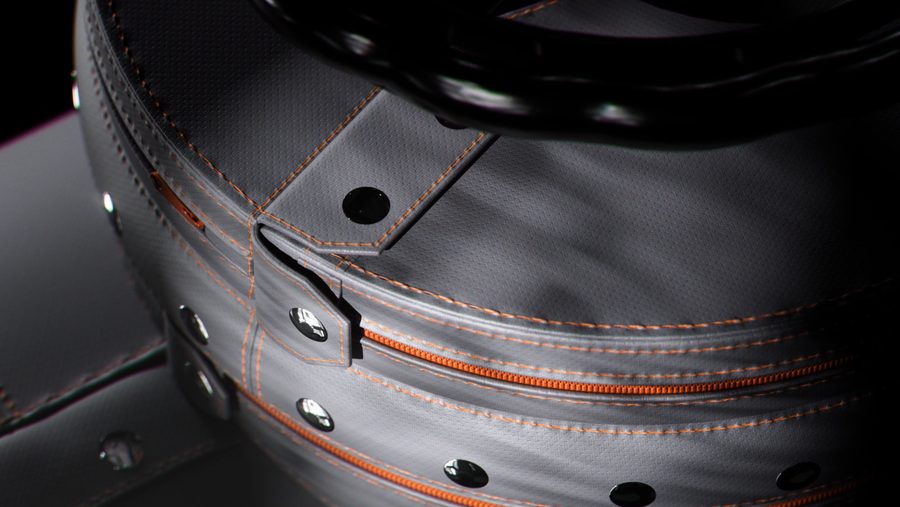
Inzonex makes modular removable insulation — structured, fitted covers with snap-button fasteners, magnets where applicable, a functional zipper, fibreglass inserts and a replaceable insulation core, tiered by temperature (needle mat / wired mat / silica), surfaces held at ≤45 °C:
