The problem
A large dairy producer had an obvious problem with condensate: inside the mechanical vapour recompression (MVR) fan of an evaporator, and inside a steam shrink tunnel on a packaging line. It affected both energy use and reliability.
MVR fan
The MVR fan takes vapour from the evaporator, compresses it and returns it to heat the evaporator. Condensate formed on the inside wall of the suction duct, before the fan. The outside of the duct stayed dry: at 69 °C it is far above the dew point of the machine room air.
Steam shrink tunnel
The tunnel runs on steam at about 92 °C. Its bare walls were cooler than the steam inside, so condensate formed on the inside of the walls and roof and dripped inside the packaging line.
Heat lost from an MVR fan has to be replaced, usually with steam from the boiler. UK best available techniques for the food, drink and milk industries list “reducing heat losses by insulation” alongside heat recovery “including mechanical vapour recompression”.BAT 6, Decision (EU) 2019/2031, legislation.gov.uk
Condensate droplets that reach an MVR fan impeller are a significant cause of blade erosion and damage. In the shrink tunnel, condensate dripped inside the packaging line.Efsan, field observations in MVR evaporator applications
The condensate forms on the vapour side and drains through steam traps. It does not touch the milk.
Losses before insulation
The MVR fan had 27 m² of uninsulated surface at an average of 77 °C. In a 21 °C machine room it lost 11.3 kW. Over 8,300 running hours that is 93.5 MWh a year.
On the suction side, 5.16 kg of condensate per hour formed inside the duct. That is 42.8 tonnes a year.


What was installed
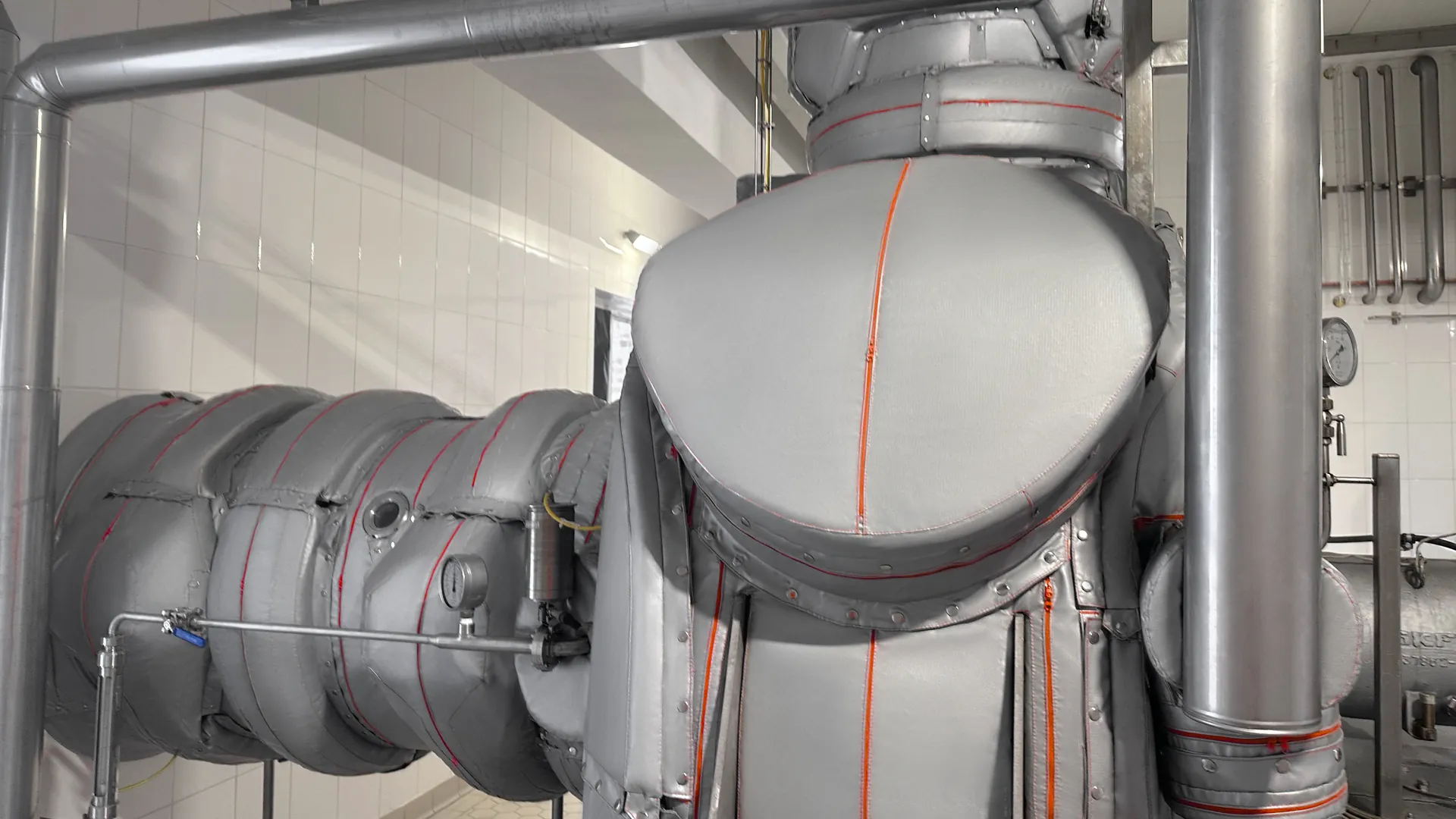
Inzonex Modular Insulation, 50 mm thick, was installed on the MVR fan: the fan casing, suction duct, discharge diffuser and vapour duct, including the expansion joint.
The bearings, shaft seal, oil system and motor were left uninsulated because they need to lose heat.


The result
| Measure | Before | After |
|---|---|---|
| Average surface temperature | 77 °C | 27 °C |
| Heat lost to the machine room | 11.3 kW | 1.3 kW |
| Condensate in the suction duct | 5.16 kg/h | 0.61 kg/h |
10.0 kW now stays in the process. Over 8,300 running hours a year that is 83 MWh, and 17.8 tonnes of CO₂e if the heat would otherwise come from a gas boiler. Condensate in the suction duct fell to 5.1 tonnes a year.
For the shrink tunnel, the same insulation is calculated to reduce condensation on the walls by 90% or more, with the outer surface at 33–35 °C.
Easy access to the equipment
Each module is made to the measured shape of the equipment, including non-obvious surfaces that other suppliers usually ignore.
Modules close with stainless steel snap buttons. There are no straps or wire to tighten, and nobody has to hold a module in place while fixing it.
The manhole, sight glass, flanges, drains and instruments each have their own removable module.
The outer surface can be washed, and the insulation core can be taken out for cleaning or replacement.
The outer surface stays below 45 °C.
The analysis was carried out by Artem Gunin. Figures are calculated from the equipment's 3D model for a 21 °C machine room. CO₂e uses the UK government conversion factor for natural gas, 0.18231 kg CO₂e per kWh (2026), with the boiler at 85% efficiency and 8,300 running hours a year. Tunnel figures come from a site calculation using the producer's own logger data.
Heat loss on your equipment