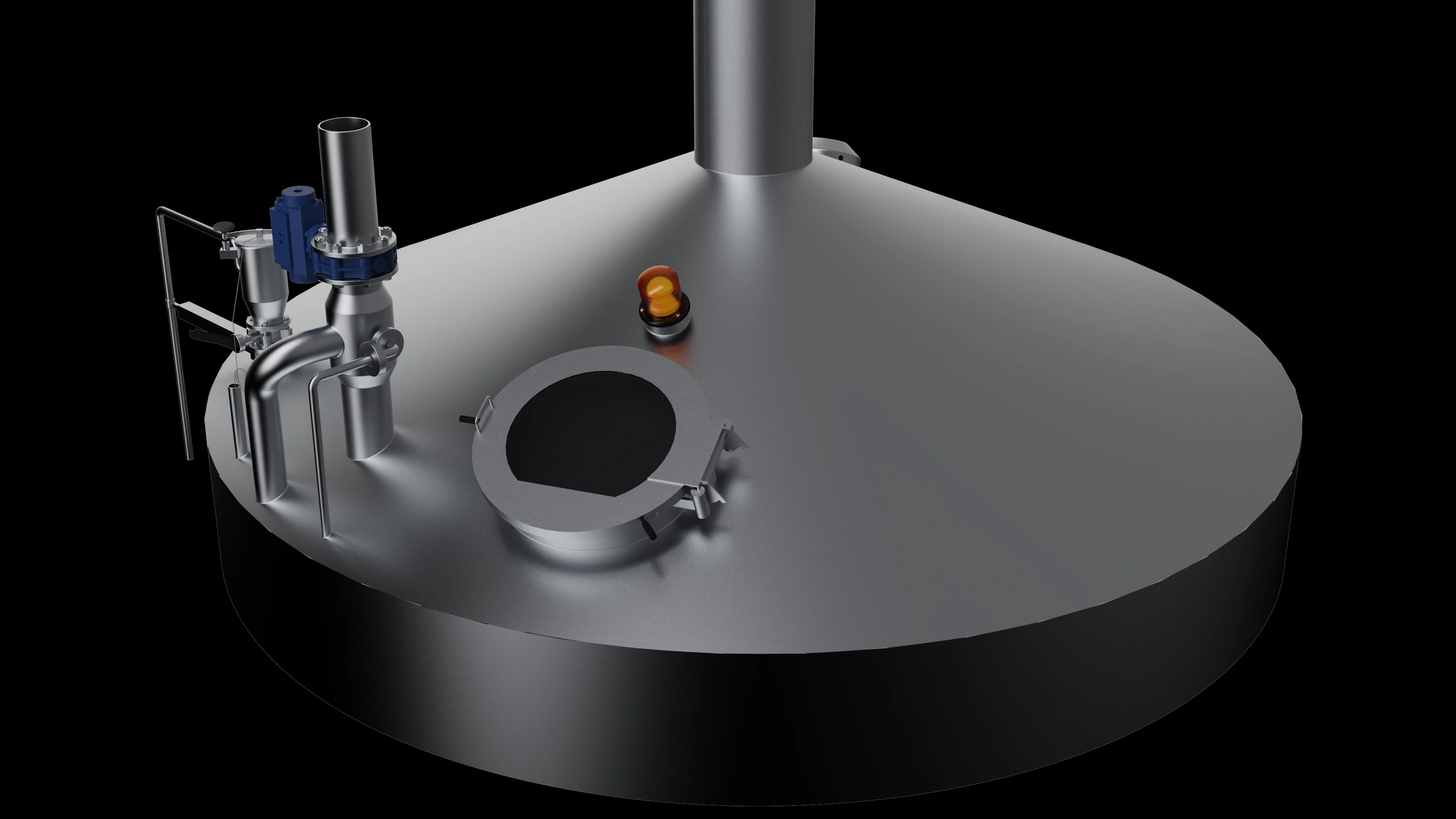
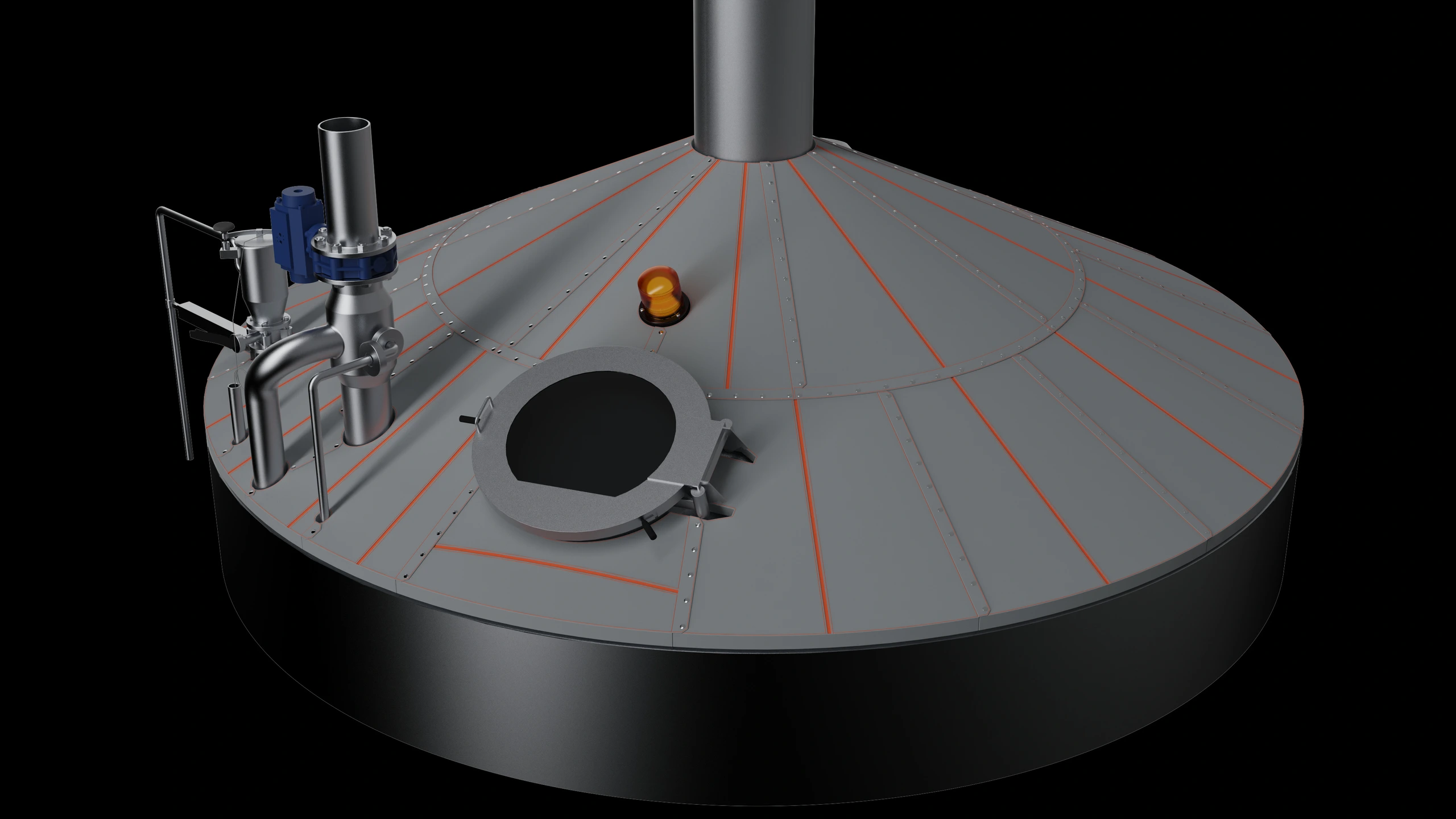
drag to compare
Insulatedouter face 29.4 °C
Baresurface 95 °C
At 95 °C · 41.6 kW bare ·
2.2 kW insulated · 29.4 °C outer face

Camera
Cover finish
Details · heat · surface · sections · calculate
The calculation covers surface heat loss only: convection and radiation from the shell, with conduction through the insulation. Heat carried away as vapour is a separate loss and is not included. Emissivity is 0.90 bare and 0.85 on the insulated face. Cost uses fuel at 94 % heat-supply efficiency and 185 kg CO₂e per MWh of fuel. The surface is treated as flat area: thermal bridges, fixings, dome curvature and gaps are not resolved separately.
Cereal cooker runs close to boiling through the whole cooking cycle. While it is working the shell is at about 95 °C. On the inputs above the calculated surface loss is 41.6 kW.
With Inzonex Modular Insulation over the same area the calculated loss is 2.2 kW, which is 94.7 % lower. At 6,600 operating hours a year that is 260.0 MWh of heat retained.
The calculation covers surface heat loss only. Heat carried away as vapour is a separate loss and is not included. The 3D model is the kettle geometry; all five vessels are calculated on the same starting area, each at its own surface temperature.
| Per vessel | Bare | Insulated |
|---|---|---|
| Surface heat loss | 41.6 kW | 2.2 kW |
| Surface temperature | 95 °C | 29.4 °C |
| Heat retained / yr | — | 260.0 MWh |
| Fuel equivalent / yr | — | 276.6 MWh |
q = h(Ts − Ta) + εσ[(Ts+273.15)⁴ − (Ta+273.15)⁴], with h = 5.7 + 3.8v W/m²K. Conductivity is taken as λ = 0.031 + 0.000188 × mean layer temperature, W/mK, evaluated at the solved mean layer temperature. Certified λ curves differ between products.
With 50 mm of mineral wool the calculated outer surface is 29.4 °C. The design target for surfaces people work next to is 45 °C. The calculated heat released into the brewhouse falls from 41.6 kW to 2.2 kW.
Inputs: 50 mm mineral wool, air 25 °C at 0.5 m/s, emissivity 0.90 bare and 0.85 on the insulated face, bare surface 95 °C. Area, temperature and hours are editable in the calculator above.
| Calculation input | Value |
|---|---|
| Insulation thickness | 50 mm |
| Ambient air | 25 °C |
| Air speed | 0.5 m/s |
| Emissivity, bare / insulated | 0.90 / 0.85 |
| Operating hours | 6,600 h/yr |
The insulation is made in separate sections around the manway, the instruments and the stack connection. Each section can be removed separately for inspection or maintenance and refitted afterwards. Vents, safety devices and required clearances stay unobstructed.
No access-time saving is included in this calculation.
| Stays accessible | How |
|---|---|
| Manway | own section |
| Instruments | own section |
| Stack connection | own section |
| Vents and safety devices | left clear |
Reference case: one vessel, 39 m², 95 °C bare surface, 6,600 operating hours a year. The retained heat is valued at £13,831 a year at £50/MWh of fuel and avoids 51.2 t CO₂e.
Natural gas at £50/MWh, 94 % heat-supply efficiency and 185 kg CO₂e per MWh of fuel. Enter the site's area, temperature, operating hours and fuel price to recalculate the results.
| Per year | Reference case |
|---|---|
| Estimated energy cost saving | £13,831 |
| Heat retained | 260.0 MWh |
| Fuel equivalent | 276.6 MWh |
| Emissions avoided | 51.2 t CO₂e |
The surface is treated as flat area: thermal bridges, fixings, dome curvature and gaps are not resolved separately.
Yes. Enter the exposed area and measured surface temperature of the cooker. The example starts at 95 °C. It estimates surface heat retained and the corresponding fuel equivalent, not changes in cooking time, evaporation or recipe performance.
For each square metre, bare heat loss combines convection and radiation: q = h(Ts − Ta) + εσ[(Ts + 273.15)⁴ − (Ta + 273.15)⁴]. The convection coefficient is estimated as h = 5.7 + 3.8v W/m²K, where v is air speed in m/s. The insulation calculation balances conduction through the layer against heat released from its outer surface. Conductivity is approximated as λ = 0.031 + 0.000188 × mean layer temperature, in W/mK. This conductivity curve is an assumption; check it against the selected insulation’s certified data. Heat retained per year = (bare kW − insulated kW) × operating hours ÷ 1,000. The calculation uses a flat-area approximation and does not separately resolve thermal bridges, fixings, dome curvature, gaps or temperature changes during a batch. Validate coverage, temperatures and material properties for a project estimate.
No. Retained heat is energy no longer lost through the modelled surface. For a fuel-fired heat supply, the fuel equivalent divides that heat by the heat-supply efficiency. This assumes the heat supply controls reduce input accordingly. A boiler nameplate efficiency alone may not include steam distribution losses. Use a consistent net or gross calorific basis for efficiency, tariff and emissions factor. The estimate does not include evaporation, flue-gas losses, batch throughput gains or measured changes in burner consumption.
No. The six camera angles are design renders for comparing bare metal with PTFE-faced or silicone-faced Inzonex insulation. Changing the inputs updates the calculation, not the renders. Confirm equipment dimensions and surface temperatures with a site survey.
Confirm the area, surface finish, measured temperatures, operating hours and access requirements. Use your energy tariff and an installed quotation for payback. The calculation covers surface heat loss only; it excludes maintenance savings and changes in equipment life or room temperature. The 45 °C outer-surface value is a design target, not a universal safe-touch guarantee. Actual contact conditions, joints and exposed parts need a site-specific check.