
Boiler-house heat loss: doors, valves and annual cost
The linked Bosch example reduces modelled heat loss from 23.4 to 1.2 kW. At 7,700 operating hours, 85% boiler efficiency and an illustrative fuel price of €0.07/kWh, that saves about €14,077 per year.
There is no single heat-loss figure for a boiler house. A useful estimate separates the shell, access doors, valves, pipework and feed-water equipment. Their areas, temperatures and operating hours differ.
Start with the equipment, not a percentage
For each component, record its exposed area or dimensions, operating temperature, existing insulation and annual duty. Use those inputs to calculate heat loss before and after the proposed insulation. Then add the component results.
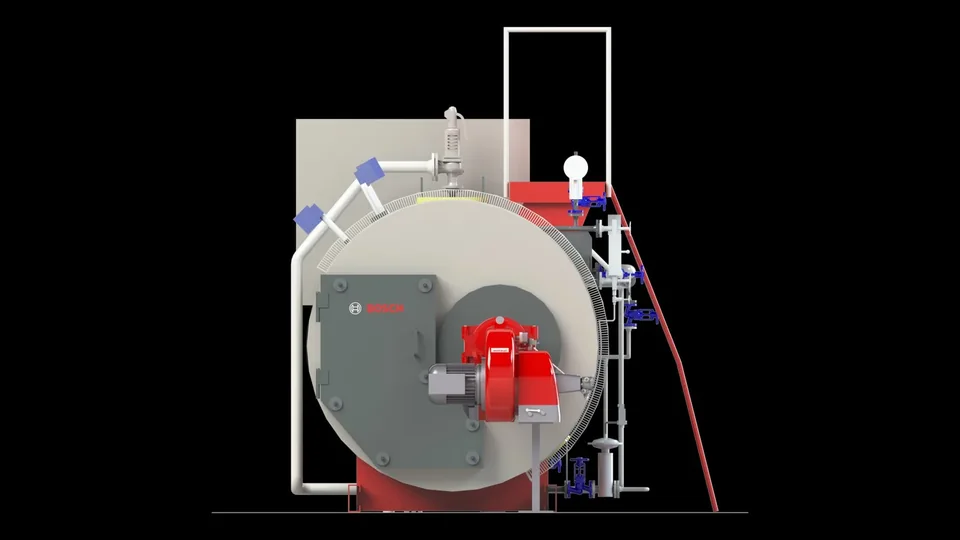
A worked boiler-house example
The published Bosch model reports 23.4 kW bare and 1.2 kW insulated across 28 pieces in 12 equipment groups. Those outputs define this example; they are not a prediction for every Bosch boiler or a result from the quick pipe calculator.
Annual heat saved is (23.4 − 1.2) × 7,700 = 170,940 kWh. At 85% efficiency, the avoided fuel input is 170,940 ÷ 0.85 = 201,105.88 kWh. Multiplying by the illustrative price of €0.07/kWh gives €14,077.41 per year.
| Quantity | Value | Unit |
|---|---|---|
| Bare heat loss | 23.4 | kW |
| Insulated heat loss | 1.2 | kW |
| Heat loss avoided | 22.2 | kW |
| Operating hours | 7,700 | h/year |
| Boiler efficiency | 0.85 | fraction |
| Annual heat saved | 170,940.0 | kWh/year |
| Annual fuel saved | 201,105.88 | kWh/year |
| Fuel price | 0.07 | EUR/kWh |
| Annual fuel cost saved | 14,077.41 | EUR/year |
The modelled heat reduction is not the same as a measured reduction in the fuel bill. Actual savings depend on operating duty, fuel price, boiler performance and whether the insulation remains fitted. For published country gas-price inputs, see the European Steam Cost Index methodology. Use the gas price per kWh, not the steam cost per tonne. Replace country reference prices with the site tariff where available; carbon costs apply only where relevant to the site.
Download worked data (CSV) · Data and calculation basis (JSON)
Do not confuse heat loss with its annual cost
A continuous 25 kW loss over 8,000 hours represents 200,000 kWh of heat. At €0.07/kWh, that is €14,000 before accounting for boiler efficiency. At 85% efficiency the corresponding fuel cost is €16,470.59. To estimate savings, use the reduction in heat loss, not the entire bare loss.
Keep maintenance separate from the energy calculation
Access doors, valves and inspection points need an insulation arrangement suited to their service requirements. Identify what must remain accessible before specifying coverage. The heat-loss calculation alone does not establish an acceptable mechanical design.
The US Department of Energy steam-system guide discusses removable insulation for fittings and says steam-trap insulation must follow the trap manufacturer's instructions. It also highlights wet or damaged insulation as a maintenance issue. This guidance supports the inspection checklist, not the Bosch example's numeric outputs.
For payback, divide the installed project cost by the estimated annual net saving. Record labour, access and replacement costs separately if they are part of the comparison. There is no fixed six-month or one-year payback that applies to every boiler house.
Questions
How much heat does an uninsulated boiler house lose?
It depends on the equipment areas, temperatures, insulation and operating conditions. The linked Bosch example reports modelled losses of 23.4 kW bare and 1.2 kW insulated; these are case inputs, not a universal boiler-house value.
How do I convert heat saved into annual fuel savings?
Multiply the reduction in heat loss, in kW, by operating hours to get kWh of heat saved. Divide by the assumed boiler efficiency to estimate fuel saved, then multiply by the fuel price per kWh.
What determines insulation payback?
Installed cost and annual net savings determine payback. Use the actual duty, tariff and project cost; do not assume that every valve or boiler door pays back within a fixed number of months.