INZONEX / COCHRAN SHELL BOILER · FRONT / BURNER DOOR
UK · EU
ISO 12241 · EN ISO 13732-1

How hot is the boiler front (burner) door?

The front door carries the burner and closes onto the furnace tube behind it — a 5.3 m² face at about 120 °C, bare. It also has to hinge open for burner service.

01 FLIR-MEASURED SURFACE TEMPS02 CAD AREAS × 1.4 BOLT/IRREGULARITY03 ISO 12241 · V = 0.5 M/S04 ISO 12241 HEAT-LOSS METHOD
€3,901energy cost saved / yr, at 60 €/MWh fuel
59 MWhheat kept in the boiler, 7,700 h/yr
13.1 tCO₂ avoided / yr, 201.6 kg/MWh
120  °CBare, FLIR-measured
01 / BARE AGAINST PANELLED

The same surface, both states

Figures are for one boiler. Surface temperatures from a real FLIR survey of a UK commercial boiler house; CAD surface areas uplifted ×1.4 for bolts and irregular geometry; ISO 12241 steady-state (50 mm core, ambient 28 °C, air movement 0.5 m/s).
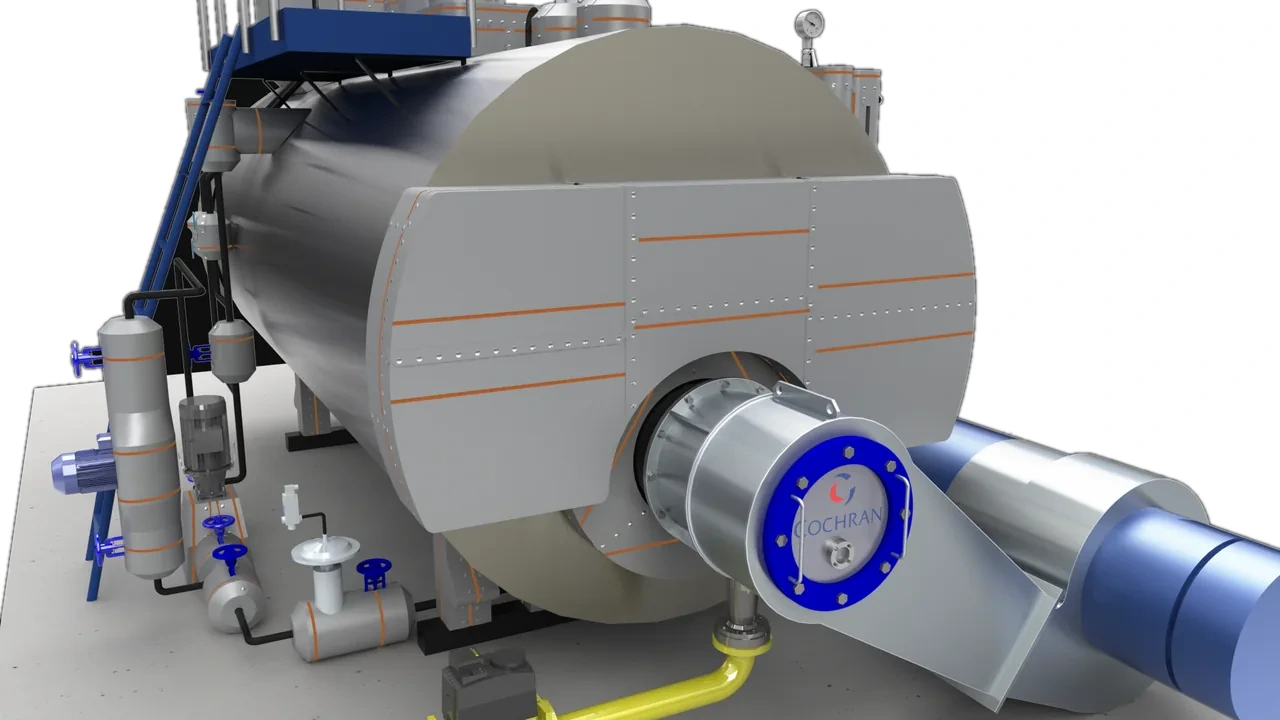
How hot is the boiler front (burner) door, bare
Bare as found
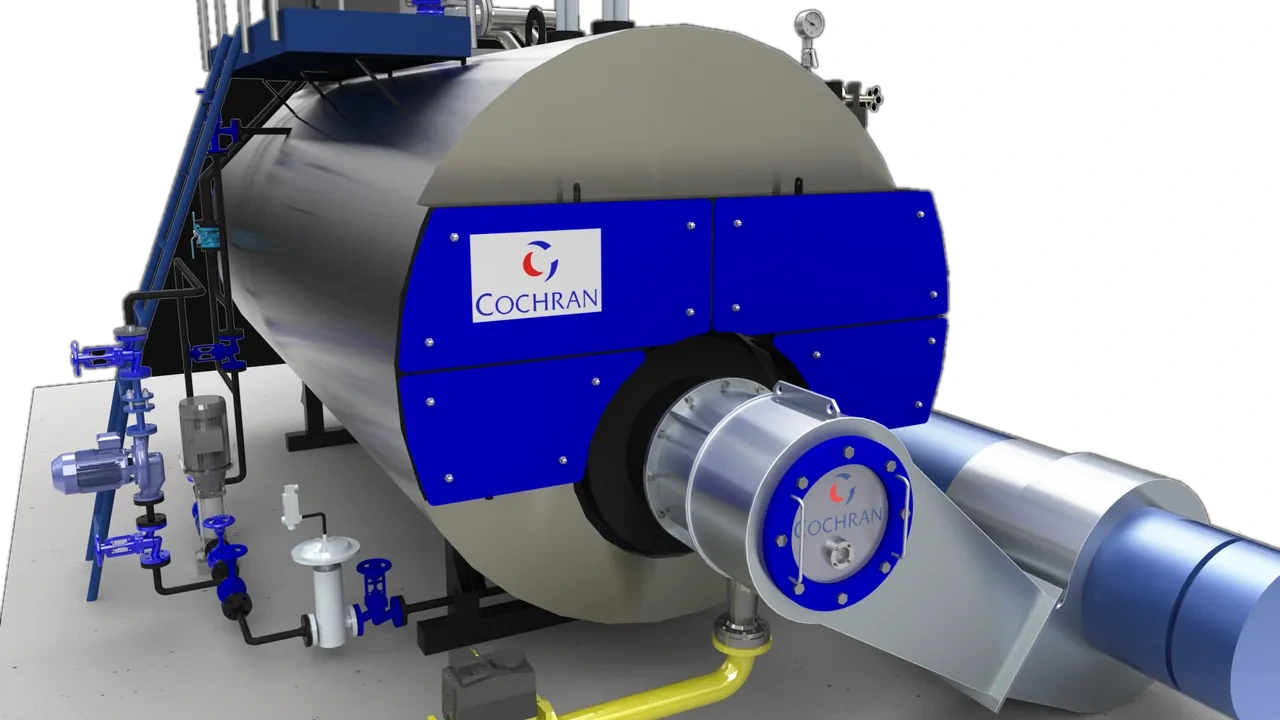
How hot is the boiler front (burner) door, insulated
Insulated surface ≤45 °C

Drag-free toggle. Visible in this view: front (burner) door — 5.3 m² at ~120 °C, with the burner mounting.3D model: Inzonex · equipment rights belong to the manufacturer

02 / WHAT YOU ARE LOOKING AT

How hot is the boiler front (burner) door

The front door is large, hot and movable — the three properties that make rigid insulation fail. It runs at 120 °C over a big flat face, so it is a real standing loss; but it swings open every time the burner is serviced, so anything hard-fixed gets damaged or removed.

A buttoned removable panel is made to the door and hinges with it: insulated when closed, out of the way when open. The burner mounting flange and sight port stay clear.

Element (this view)Temp °CArea m²Bare WInsulated WSurface °CCut
Front (burner) door1205.327,97341634−95%
Front / burner door view, per boiler5.37,973416≤45−95%

ISO 12241, 50 mm Inzonex modular core, ε(bare)=0.9, ε(jacket)=0.85, hconv at 0.5 m/s. Insulated figures are conservative steady-state.

03 / ELEMENT BY ELEMENT

Why each one is left bare — and how it gets insulated

Front (burner) door · 120 °C · 8 kW bare

The front door carries the burner and closes onto the furnace tube, so it runs hot across a 5.3 m² face. It hinges open for burner service, which is exactly why rigid insulation fails here — a buttoned removable panel insulates the door and opens with it.

Cover: Silicone shell + PAROC stone-wool core (50 mm) · touch-safe design target ≤45 °C (ISO 13732-1 guidance)

Every module here re-opens for access.

04 / MATERIALS & STANDARDS

What the cover is — and what it meets

Every surface on this view is covered by an Inzonex modular removable panel: a PAROC stone-wool core (50 mm) in a silicone outer shell — or a more durable PTFE shell as an option. The form-fitting build unbuttons for access and refits after each maintenance cycle. The outer surface drops to a touch-safe ≤45 °C.

ISO 12241 heat-loss methodISO 13732-1 ≤45 °C touch-safeEN 13501-1 reaction to fireASTM C680 heat-loss method

Industries that run this boiler

Brewery & beverageFood processingDairySugar & confectioneryDistillingChemical & petrochemicalPharmaceuticalTextile & dyeingPaper, pulp & packagingRubber & tyrePlasticsTobaccoPower & CHPOil & gas / refiningHospitals & healthcareCommercial laundryHotels & hospitalityUniversities & district heatingEdible oilAnimal feed
05 / TAKE IT FURTHER

From this surface to the number that matters

06 / FAQ

Quick answers

How hot is a boiler front door?

On the surveyed Cochran the front (burner) door measured ~120 °C over a 5.3 m² face, bare — roughly 8 kW of standing loss.

Can the burner door be insulated if it opens for service?

Yes — a removable panel is shaped to the door and hinges with it, insulated when closed and clear of the burner mounting and sight port when open.

What surface temperature after insulation?

About 34 °C — below the 45 °C touch-safe threshold — a ~95% cut in loss.

07 / COMBINATION

Watts per square metre

Selected readings from this boiler survey. This surface is the marked point.

04008001,2001,6002,0002,4002,8003,200100120140160180200W / m2SURFACE C1117feed pump1499front door1620economiser1704end plate2888check valveMeasured loss divided by CAD area, 5 Inzonex readings. ISO 12241:2022 steady state.
08 / PROCEDURE

Opening the front door

On the Cochran the front door is a single hinged plate carrying the burner: 5.32 m² at about 120 °C, one element group, 7,973 W bare. It swings clear of the furnace tube, so the module comes off the door before the door moves.

Opening the front door, and what the insulation has to allow

The front door carries the burner and closes the furnace. It is opened for tube ends, refractory and burner head, and it is hinged, so anything wrapped across the hinge line is cut the first time it swings.

  1. Take the boiler off line and prove the fuel isolation. The burner is isolated and the isolation proved before the door is released. Nothing on the door is touched with the burner live.
  2. Let the furnace cool. The outside of the door runs at 120 °C on the Cochran and 96 °C on the Bosch UL-S while the boiler is working. The refractory behind it holds heat far longer than the outside shows.
  3. Take the module off before the door moves. The panel releases at its fastenings and comes away whole. It comes off the door before the door moves, so its weight never hangs on the hinge.
  4. Release the door fastenings in the pattern given by the maker. Doors are dogged down in a sequence, and the sequence exists so the joint stays flat. Undoing them at random distorts the seal.
  5. Swing the door clear and support it. The burner rides on the door and its weight is on the hinge. The door is supported while work goes on.
  6. Do the work: tube ends, refractory, burner head. The door is opened for this on a cycle. Fixed lagging is cut at this step and is not refitted.
  7. Close, re-dog in sequence, refit the same module. The panel goes back onto the same geometry, and the burner flange keeps its clearance. On the Bosch the flange alone is 146 °C over 0.85 m², which is 1,780 W bare.

Inzonex did not operate the burner or the door. What we measured is the outside of the door and the flange while the boiler was running: on the Cochran 120 °C over 5.32 m², 7,973 W; on the Bosch UL-S 96 °C over 2.33 m² plus a 146 °C flange, 4,310 W together.

09 / EVIDENCE

Where each number comes from

SurveyCochran, front / burner door. FLIR S62 Pro, emissivity 0.90, reflected 25 °C, 3 m, full radiometric correction. Peak on this view 120  °C.
GeometryRebuilt in CAD from the surveyed machine. This view carries 1 element group(s) and sheds 8  kW bare. The ×1.4 factor is a geometry allowance for bolts, seams and irregular surface — it is not a measured area.
CalculationISO 12241 steady state. Heat loss is calculated from the measured surface temperature and the modelled area — it is not metered. Full method, basis and limits.
Largest single itemFront (burner) door, 8  kW on this view.
10 / SURFACE BY SURFACE

The other surveyed surfaces on this Cochran