Cochran shell boiler · Rear / back-plate view
How hot is a Cochran boiler back plate?

On a working Cochran package boiler the rear back plate and the economizer behind it run at 126–130 °C — FLIR-measured, bare. Together they are the single largest uninsulated heat loss in the boiler house.

FLIR-measured surface temps CAD areas × 1.4 bolt/irregularity ISO 12241 · v = 0.5 m/s
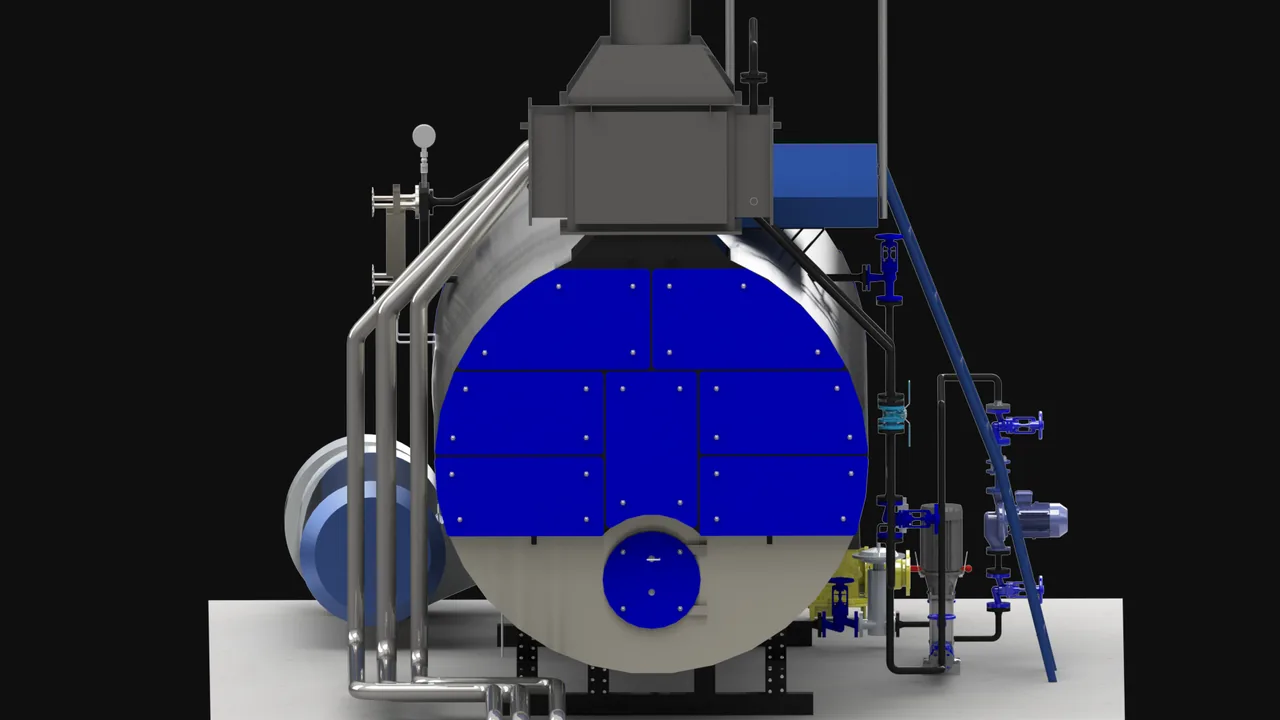
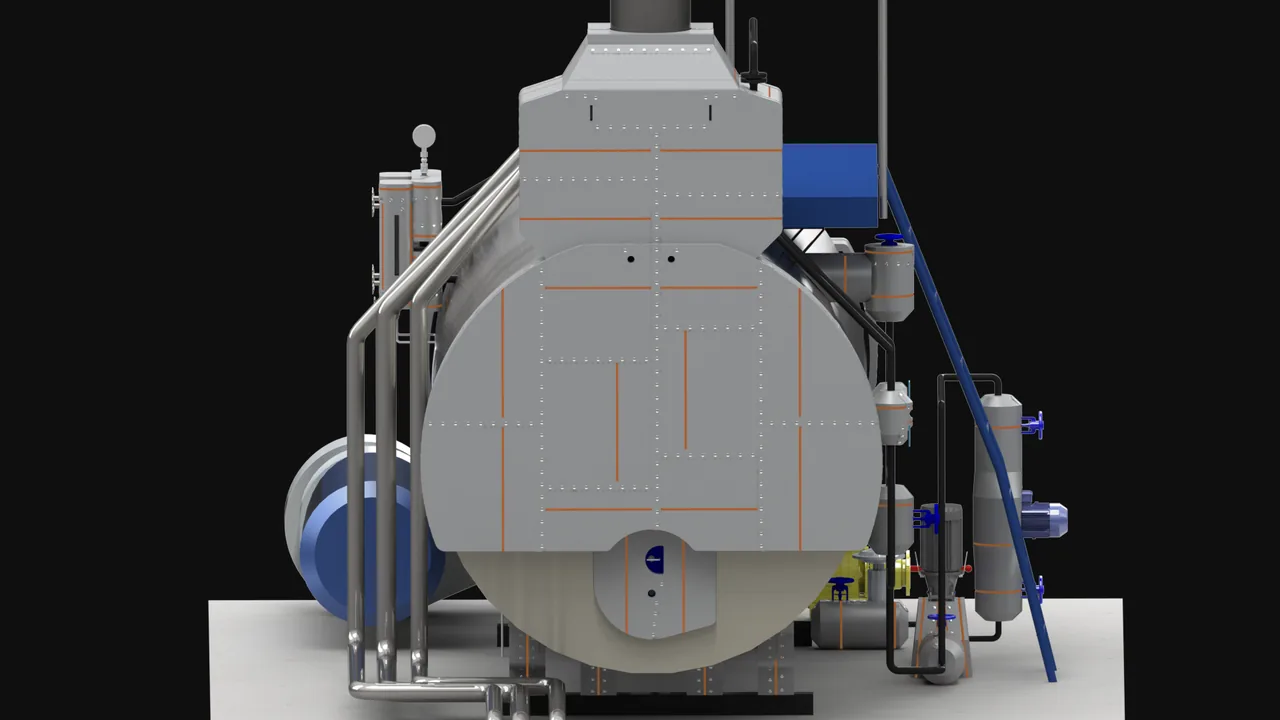
How hot is a Cochran boiler back plate — bare metal, 3D model
This view. Visible in this angle: back plate (130 °C), economizer (126 °C), behind it — both bare.3D model: Inzonex · equipment rights belong to the manufacturer
Peak surface
130 °C
Bare, FLIR-measured
Largest loss
18.3 kW
Economizer
This view, bare
27.4 kW
2 element group(s)
After insulation
≈95%
Surface drops to ≤45 °C

Figures are for one boiler. Surface temperatures from a real FLIR survey of a UK commercial boiler house; CAD surface areas uplifted ×1.4 for bolts and irregular geometry; ISO 12241 steady-state (50 mm core, ambient 28 °C, air movement 0.5 m/s).

What you are looking at

How hot is a Cochran boiler back plate

The rear (back) plate of a Cochran shell boiler closes the reversal chamber, so the full flue-gas temperature presses against it — 130 °C across a 5.3 m² face. Bolted directly behind it sits the economizer, an 11.3 m² finned block at 126 °C that recovers flue heat but is almost always left completely bare because its shape resists rigid cladding.

These surfaces are the largest avoidable loss in the room. Running 8,000+ hours a year, the back of one boiler radiates tens of kilowatts continuously into the boiler-house air.

Element (this view)Temp °CArea m²Bare WInsulated WSurface °CCut
Rear (back) plate1305.329,06347135−95%
Economizer12611.3118,32795434−95%
Rear / back-plate view view, per boiler16.627,3901,425≤45−95%

ISO 12241, 50 mm Inzonex modular core, ε(bare)=0.9, ε(jacket)=0.85, hconv at 0.5 m/s. Insulated figures are conservative steady-state, not best-case.

Element by element

Why each one is left bare — and how it gets insulated

Rear (back) plate · 130 °C · 9.1 kW bare

A large, mostly flat face carrying the reversal-chamber heat. Easy to insulate, high payback — but usually left bare because it is “just the back”. A removable panel drops it from 130 °C to ≈35 °C and removes a burn hazard behind the boiler.

Economizer · 126 °C · 18.3 kW bare

The biggest prize and the most-skipped surface. Finned tube blocks and access doors make rigid lagging impractical, so economizers run uninsulated for their whole life. An Inzonex panel is shaped to the casing and re-opens for tube access, keeping recovered heat in the gas path.

Geometry that re-opens for access is the core idea behind the Inzonex modular design (UK patent application GB2508992.1).

Take it further

From this surface to the number that matters

FAQ

Quick answers

How hot is a Cochran boiler back plate?

On the surveyed boiler the rear back plate measured 130 °C bare (FLIR) over a 5.3 m² face; the economizer behind it ran at 126 °C.

How much heat does a bare economizer lose?

About 18 kW continuously — 126 °C over 11.3 m² (CAD ×1.4) by ISO 12241 — the largest single avoidable loss on the boiler.

Can an economizer be insulated if it needs tube access?

Yes. A modular removable panel is shaped to the casing and unbuttons for inspection, so it insulates without losing access, unlike rigid cladding.

What surface temperature do you reach after insulation?

About 34–39 °C — below the 45 °C touch-safe threshold — with roughly a 95% cut in heat loss.

More of this boiler

Other surveyed views

Every face of the Cochran model has its own measured surfaces. Explore them from the 3D hub.