
AI water consumption: what the numbers measure
The 0.5-litre claim is a modelled GPT-3 range for 10-50 responses, not every ChatGPT question. Google's 0.26 mL statistic covers a different workload and onsite cooling only.
Published water figures
11 claims shown
| Claim | Metric | Boundary | Place / year | Native value | Normalised volume | Status | Source | Do not lose this qualifier |
|---|---|---|---|---|---|---|---|---|
| Gemini Apps text prompt: reported median water consumption | Consumption | Operational onsite cooling; comprehensive serving approach | Google data centres supporting Gemini Apps May 2025; WUE from 2024 | 0.26 mL per median text prompt | 0.00026 L per source-derived median text prompt | Derived | Google Sections 3.3-3.4; Table 2, comprehensive approach; May 2025 | Derived from energy and prior-year consumptive WUE, not water metered per prompt. Excludes electricity-generation and embodied water. The statistic uses model-average energy weighted by prompt counts, not individual-prompt water measurements. Not a universal factor or a mean for estimating totals. |
| GPT-3 training in Microsoft US data centres: onsite water consumption | Consumption | Onsite cooling | United States Model example | 700000 litres per training run | 700000 L per modelled training run | Modelled | Communications of the ACM Estimating AI's Water Footprint; GPT-3 example; Water Withdrawal versus Water Consumption | Modelled GPT-3 example, not a measured OpenAI or Microsoft disclosure and not transferable to another model or site. |
| GPT-3 training example: onsite plus electricity-related water consumption | Consumption | Operational onsite + electricity | United States Model example | 5400000 litres per training run | 5.4 million L per modelled training run (includes onsite) | Modelled | Communications of the ACM Estimating AI's Water Footprint; GPT-3 example; Water Withdrawal versus Water Consumption | Includes modelled offsite electricity water; do not compare directly with onsite-only WUE or corporate withdrawal. |
| Medium-length GPT-3 responses: modelled water consumption range | Consumption | Operational onsite + electricity | Location and time dependent Model example | 0.5 L per 10-50 responses | 0.01-0.05 L per modelled medium-length response | Modelled | Communications of the ACM Estimating AI's Water Footprint; GPT-3 example; Water Withdrawal versus Water Consumption | Derived range for the paper's GPT-3 scenario, not a universal ChatGPT, image-generation or reasoning-model factor. |
| Global AI demand in 2027: projected water withdrawal | Withdrawal | Operational onsite + electricity | Global 2027 projection | 4.2-6.6 billion m3 | 4.2-6.6 trillion L per year (2027 projection) | Modelled | Communications of the ACM Estimating AI's Water Footprint; GPT-3 example; Water Withdrawal versus Water Consumption | Projection of withdrawal, not consumption and not a measured 2027 total. |
| Microsoft zero-water cooling design: estimated water use avoided | Avoided use | Onsite cooling | Not specified Design estimate | 125000 m3 per facility-year | 125 million L per facility-year (avoided-use estimate) | Estimated | Microsoft Our progress, Water positive | Avoided-use design estimate, not observed withdrawal or consumption for Microsoft's fleet. |
| Google 2024 water replenishment | Replenishment | Global operations | Global 2024 | 4500000000 gallons per year (gallon type not stated in highlight) | 17 billion L per year (assuming US gallons) | Reported | Google 2024 water replenishment highlight | The source highlight reports a rounded 4.5 billion gallons without defining gallon type. The litre conversion assumes US gallons and is approximately 17 billion L, not additional source precision. Replenishment is not withdrawal or consumption and cannot automatically be subtracted. |
| Google 2024 freshwater-consumption replenishment ratio | Replenishment ratio | Google-reported freshwater-consumption baseline | Global 2024 | 64 percent | Not a volume | Reported | Google 2024 water replenishment highlight | A percentage, not a water volume and not an AI-specific metric. |
| Meta data-centre water withdrawal | Withdrawal | Data-centre operations | Global reported facilities 2024 | 4145 megalitres per year | 4.14 billion L per year (2024 operations) | Reported / estimated mix | Meta Sections 3.1 Water Withdrawal and PUE/WUE; 2024 data | Corporate data-centre withdrawal, not AI-only consumption; incomplete activity data can use proxies under Meta's method. |
| Meta annual data-centre water usage effectiveness | Withdrawal intensity | Data-centre withdrawal / IT electricity | Global data-centre fleet 2024 | 0.19 litres per IT kWh | Not a volume | Reported / estimated mix | Meta Sections 3.1 Water Withdrawal and PUE/WUE; 2024 data | Withdrawal intensity, not consumption per query and not a workload-level AI benchmark. |
| Meta data-centre construction water excluded from operational withdrawal total | Withdrawal | Data-centre construction | Global reported projects 2024 | 1019 megalitres per year | 1.02 billion L per year (2024 construction) | Reported | Meta Sections 3.1 Water Withdrawal and PUE/WUE; 2024 data | Reported separately and excluded from Meta's 2024 operational withdrawal table. |
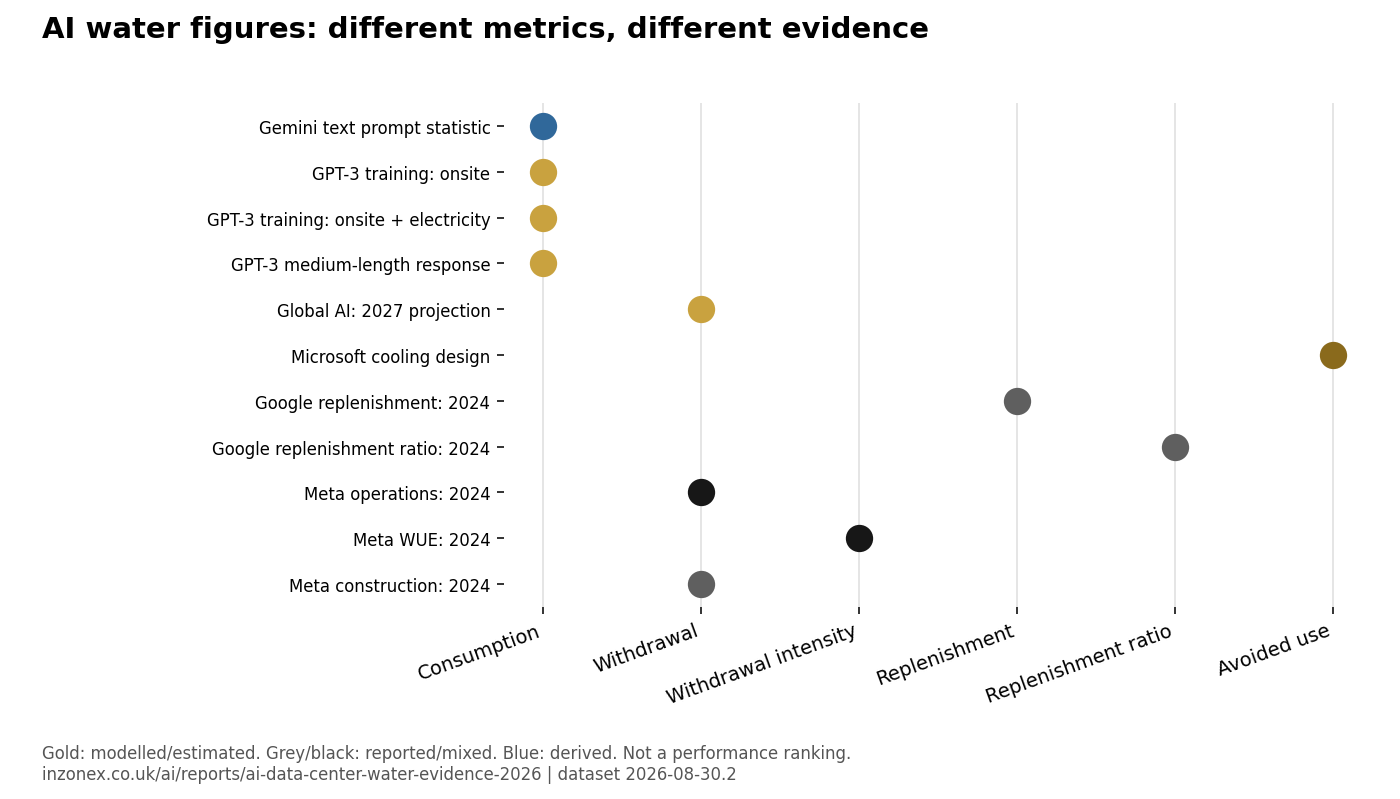
Why the numbers conflict without actually disagreeing
These 11 selected published figures keep their source, year, unit and what was counted. This is an evidence snapshot, not a 2026 usage total or a ranking of AI services.
The GPT-3 training example has two different totals because one is onsite cooling consumption and the other adds electricity-related water. Meta reports data-centre withdrawal and withdrawal intensity, while Google highlights replenishment. Microsoft describes avoided water use for a design. Those values cannot answer the same question even after conversion to litres.
What does Google's 0.26 mL figure include?
Google's serving study reports a median for Gemini Apps text prompts in May 2025. Water is derived from energy and the previous year's consumptive water-use effectiveness, rather than metered for each prompt. It excludes water for electricity generation and manufacturing. The paper builds the statistic from model-average energy weighted by prompt counts; multiplying it by your number of questions does not give a measured total. Google, sections 3.3-3.4 and Table 2.
Four different water terms
- Withdrawal
- Water taken from a surface, groundwater or utility source. Some may be returned.
- Consumption
- The portion not returned to the same catchment in a usable form, including evaporation.
- Replenishment
- A restoration or stewardship claim, not the same physical flow as withdrawal.
- Avoided use
- A design estimate relative to a baseline, not observed water use across a company's facilities.
How to cite a water claim
- Name the metric: withdrawal, consumption, replenishment, intensity or avoided use.
- Name the boundary: onsite cooling, electricity-related water, construction, or a corporate operating boundary.
- Keep the geography and time period.
- State whether the source measured, reported, estimated or modelled the value.
- Do not relabel an all-data-centre number as AI-only.
Method and limits
Native values are preserved. Cubic metres and megalitres use 1 m3 = 1,000 litres and 1 ML = 1,000,000 litres. The Google replenishment conversion assumes US gallons at 3.785411784 litres; the source highlight does not specify gallon type. Rounded source figures do not become precise measurements through conversion. Percentages and L/kWh intensities are not converted into standalone volumes. Inzonex adds no workload estimate, company ranking or performance score.
Questions
Does one AI prompt use a bottle of water?
No universal per-prompt factor exists. The published 0.5-litre claim is a modelled GPT-3 range for 10-50 medium responses and varies with location, time, cooling and electricity generation.
Are water withdrawal and water consumption the same?
No. Withdrawal is water taken from a source; consumption is the portion not returned to the same catchment in a usable form. A source can report either or both.
Can water replenishment be subtracted from withdrawal?
Not automatically. Replenishment needs matching geography, timing, quality and accounting rules before it can be compared with withdrawal or consumption.
Is corporate data-centre water use the water footprint of AI?
No. Corporate data-centre totals include many workloads and facilities. They are not AI-only unless the source explicitly isolates AI.
What does WUE measure?
Water usage effectiveness is a water-volume intensity per unit of IT electricity. Its numerator may be withdrawal or consumption depending on the reporter, so the definition must travel with the number.
Sources and reuse
- Google: Measuring the environmental impact of delivering AI at Google Scale (2025-08-21). Locator: Sections 3.3-3.4; Table 2, comprehensive approach; May 2025. Google and author rights retained; original paper is not redistributed in downloads.
- Communications of the ACM: Making AI Less 'Thirsty' (2025-06-17). Locator: Estimating AI's Water Footprint; GPT-3 example; Water Withdrawal versus Water Consumption. Underlying article rights remain with ACM and the authors. Values are quoted with attribution.
- Microsoft: 2025 Environmental Sustainability Report announcement (2025-05-29). Locator: Our progress, Water positive. Microsoft source rights retained.
- Google: 2025 Environmental Report (2025). Locator: 2024 water replenishment highlight. Google source rights retained.
- Meta: 2025 Environmental Data Index (2025). Locator: Sections 3.1 Water Withdrawal and PUE/WUE; 2024 data. Meta source rights retained.
Suggested citation: Inzonex (2026), AI water consumption: what the numbers measure, evidence snapshot 2026-08-30.2. Inzonex compilation, classifications, unit conversions and original chart: CC BY 4.0. This does not license upstream publications, site code, fonts or logos. Sources are linked, not redistributed.
Electricity evidence · All research reports · Editorial methodology