
Requirements-based procurement guide
CMMS vs EAM
Choose from requirements, not the bigger label. Work orders, preventive maintenance, spares and condition data can exist in both routes. The key difference is whether you also need lifecycle, capital, financial and enterprise asset governance.
Which scope should enter procurement?
Select only requirements you can support with a responsible team, process and acceptance test. The score counts scope signals; it does not score products or organisational maturity.
Maintenance execution appears to be the main scope. Verify integrations before assuming a separate EAM layer is needed.
Requirements screen only; not an ISO rule, certification result or product recommendation.
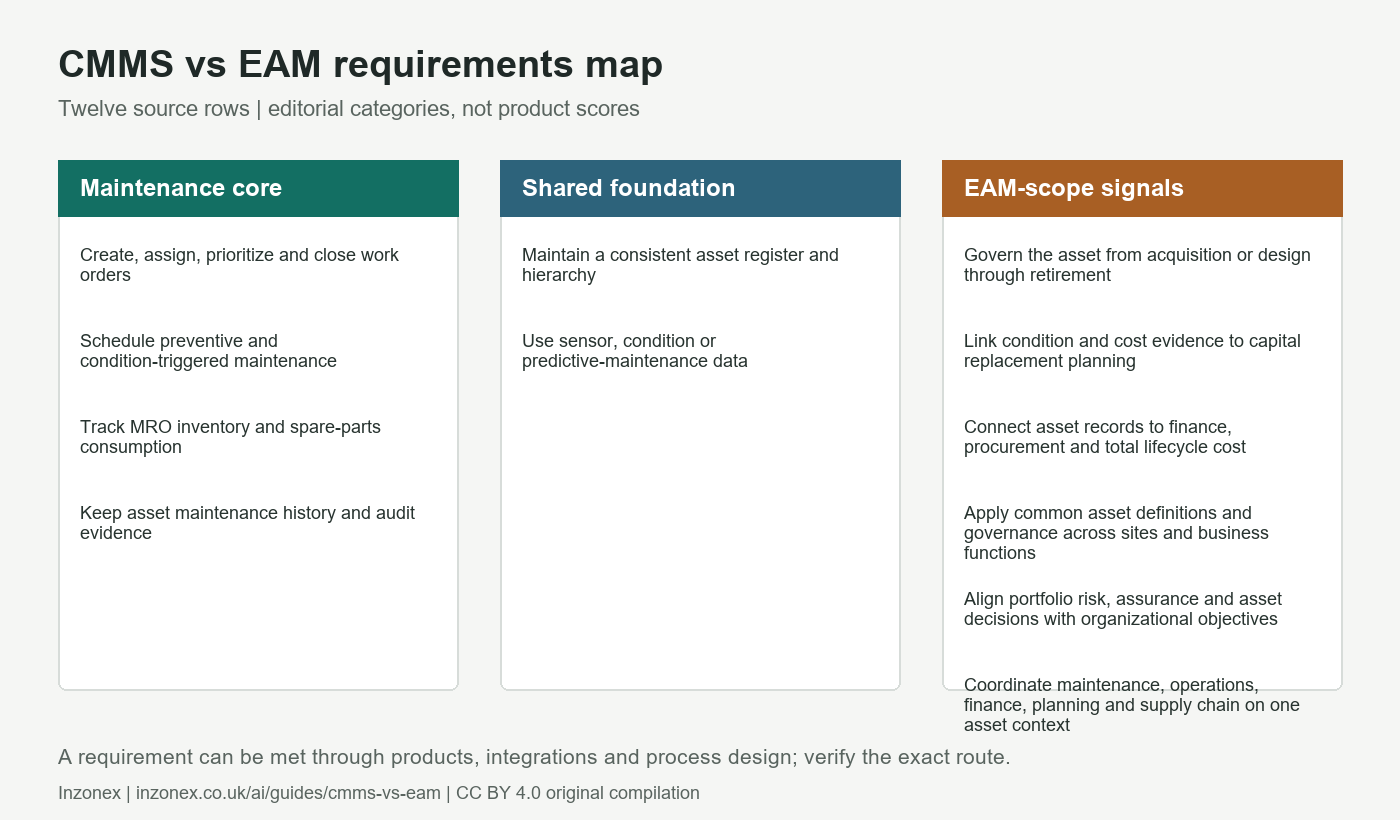
Source-linked requirements matrix
A blank or narrower CMMS column does not mean a specific product lacks the capability. Verify the current edition, connector, data ownership and commercial scope.
| Requirement | CMMS coverage | EAM coverage | How to use it and sources |
|---|---|---|---|
| Create, assign, prioritize and close work orders | Core documented CMMS function | Also expected inside EAM maintenance scope | Not a discriminator by itself |
| Schedule preventive and condition-triggered maintenance | Documented CMMS function | Also present in EAM work management | Not a discriminator by itself |
| Track MRO inventory and spare-parts consumption | Documented CMMS function | Can connect to wider supply-chain processes | Integration depth matters more than the label |
| Keep asset maintenance history and audit evidence | Documented CMMS function | Part of a broader governed asset record | Not a discriminator until cross-functional records are required |
| Maintain a consistent asset register and hierarchy | Needed for reliable maintenance records | Extended across lifecycle and enterprise processes | Test hierarchy depth, ownership and synchronization |
| Use sensor, condition or predictive-maintenance data | Modern CMMS can ingest condition data and trigger work | EAM can contextualize condition with enterprise plans | Not a discriminator; test the exact data route |
| Govern the asset from acquisition or design through retirement | Maintenance-stage records may contribute | Full-lifecycle scope is a defining EAM signal | Add one EAM-scope signal |
| Link condition and cost evidence to capital replacement planning | Can supply maintenance cost and condition history | Capital and lifecycle planning are broader EAM scope | Add one EAM-scope signal |
| Connect asset records to finance, procurement and total lifecycle cost | Connector or ERP handoff may be sufficient | Cross-functional financial and supply-chain context is a common EAM boundary | Add one EAM-scope signal |
| Apply common asset definitions and governance across sites and business functions | A multi-site CMMS may still satisfy the requirement | Enterprise-wide governed asset data is a strong EAM evaluation signal | Add one EAM-scope signal, then verify actual product scope |
| Align portfolio risk, assurance and asset decisions with organizational objectives | Maintenance evidence is an input, not the whole management system | Broader asset-management governance may require EAM plus process change | Add one EAM-scope signal; software alone does not establish ISO conformity |
| Coordinate maintenance, operations, finance, planning and supply chain on one asset context | May be handled through integrations and operating procedures | Cross-functional lifecycle coordination is a common EAM signal | Add one EAM-scope signal |
Compare the scope, then test it
What this module teaches
- Separate maintenance execution from full-lifecycle asset governance.
- Treat site count, predictive maintenance and mobile work as requirements to test, not automatic category labels.
- Convert each selected signal into an acceptance test, a responsible integration team and commercial scope.
- Freeze the six scope signals before supplier demos.
- Run the same blank checklist against a CMMS-plus-integration route and an EAM route where the result is mixed.
- Keep screenshots, exports, interface mappings and written exclusions with the decision.
Provider: Inzonex. Free self-study procurement resource; no certification or qualification is awarded.
CMMS vs EAM questions
What is the main difference between CMMS and EAM?
CMMS concentrates on maintenance execution such as work orders, preventive schedules, spares and history. EAM evaluates the broader lifecycle and cross-functional governance of assets. Product boundaries overlap, so requirements and integrations matter more than the label.
Can a multi-site company still use a CMMS?
Yes. Site count alone does not prove that EAM is required. Test hierarchy, permissions, data ownership, finance and procurement integration, lifecycle planning and reporting across the actual sites.
Does ISO 55001 require EAM software?
No. ISO 55001 specifies requirements for an asset-management system, while an organization determines the assets and processes in scope. This page does not treat buying software as certification or conformity.
Is predictive maintenance an EAM-only feature?
No. Current CMMS documentation also describes condition data and predictive-maintenance workflows. Verify sensors, event handling, false alerts, work-order creation and evidence retention in the actual product.
Is the decision result a product recommendation?
No. It is an Inzonex triage of six scope signals. Use the downloadable checklist to verify requirements, integrations, commercial scope and acceptance evidence with shortlisted suppliers.
Sources, method and reuse
- ISO 55000:2024 overviewstandards-body overview; checked 2026-08-29. Asset management aligns asset objectives with organizational objectives and manages assets through their life cycles to realize value.
- ISO/TC 251 ISO 55001 overviewstandards-body overview; checked 2026-08-29. ISO 55001 specifies requirements for establishing, implementing, maintaining and improving an asset-management system; organizations determine the assets in scope.
- IBM: What is a CMMS?vendor educational documentation; checked 2026-08-29. CMMS core functions include work orders, preventive and predictive maintenance scheduling, spare-parts inventory, mobile access and reporting.
- IBM: What is enterprise asset management?vendor educational documentation; checked 2026-08-29. EAM covers the asset lifecycle from procurement to disposal and combines maintenance with planning, supply-chain and EHS scope.
- SAP: What is enterprise asset management?vendor educational documentation; checked 2026-08-29. EAM connects lifecycle asset information across maintenance, operations, finance, planning and supply-chain processes.
- IBM: CMMS vs EAMvendor educational comparison; checked 2026-08-29. CMMS focuses predominantly on maintenance, while EAM has broader lifecycle and cross-functional scope.
A source-linked requirements map for deciding whether maintenance execution is the main procurement problem or whether full asset-lifecycle governance must be evaluated. Inzonex compiled the classifications and screening thresholds; they are not ISO requirements or vendor performance results.
The original requirements compilation, triage logic, chart and blank checklist are CC BY 4.0 with attribution to Inzonex. Source facts, standards, vendor documentation and trademarks retain their respective rights.
Suggested citation: Inzonex, CMMS vs EAM: requirements decision tree and checklist, version 2026-08-29.1, https://inzonex.co.uk/ai/guides/cmms-vs-eam.