
UK home energy · editable tariff model
Heating cost calculator
Compare a gas boiler, direct electric heating and a heat pump against the same annual delivered-heat requirement. Replace every preset with the tariff and seasonal performance that apply to the property.
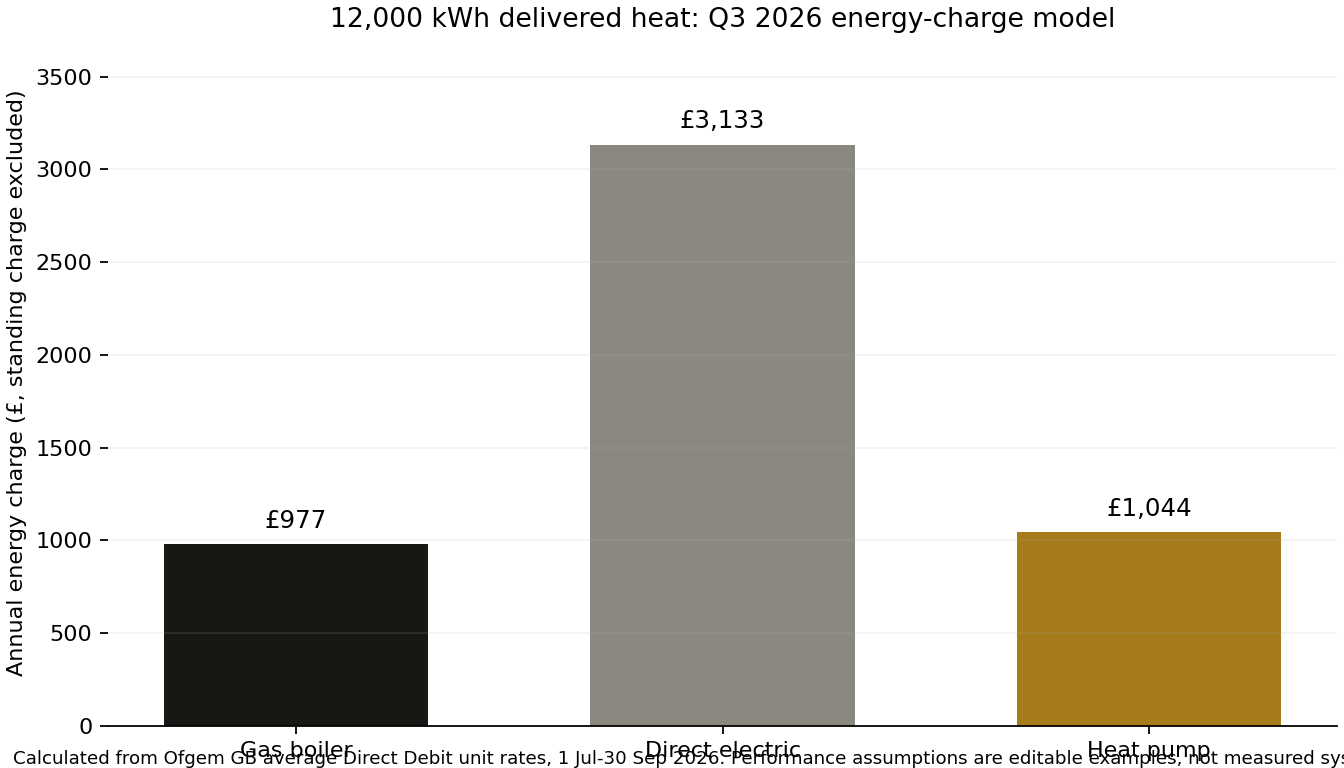
Worked answer: at 12,000 kWh of delivered heat using Ofgem's 1 July-30 September 2026 average Direct Debit unit rates, the energy-charge model gives about £977/year for a 90% gas boiler, £1,044/year for a heat pump at COP 3.0 and £3,133/year for direct electric heating. Standing charges are excluded until explicitly enabled.
Enter one heat requirement
Then edit rates and seasonal performance for each option.
Gas boiler
Direct electric heating
Heat pump
Check that heat demand, rates and performance values are positive and within the displayed input limits.
Open method
How the calculation works
energy charge = input energy × unit rate
total = energy charge + optional standing charge
A seasonal efficiency below 1 increases fuel input relative to delivered heat. A heat-pump COP above 1 reduces electrical input relative to delivered heat. These values are assumptions supplied by the user; the tool does not estimate them from appliance marketing data.
Static worked data
Q3 2026 comparison table
The same 12,000 kWh annual delivered-heat requirement is used for every row. This is a reproducible example, not a forecast for a particular home.
| System | Efficiency / COP | Unit rate | Input kWh | Energy only | With full standing |
|---|---|---|---|---|---|
| Gas boiler | 0.90 | 7.33p | 13,333 | £977.33 | £1,083.33 |
| Direct electric heating | 1.00 | 26.11p | 12,000 | £3,133.20 | £3,341.94 |
| Heat pump | 3.00 | 26.11p | 4,000 | £1,044.40 | £1,253.14 |
Sources and boundary
Ofgem's unit-rate page supplies the Q3 and announced Q4 average Direct Debit presets for England, Scotland and Wales. Ofgem's Q3 announcement confirms the active-quarter averages and explains that actual bills depend on consumption, region, meter and payment method. The performance values are editable examples, not Ofgem data.
Engineering learning
What this tool teaches
Inzonex Engineering Learning publishes this free worked calculator to separate delivered heat, purchased energy, tariff rates and fixed charges. Save the export alongside a quote so the comparison can be reproduced.
Open the calculator learning catalogue · Estimate fabric U-values · Check dew-point margin
Heating cost questions
How does the heating cost calculator compare gas, electric heating and a heat pump?
It divides the same annual delivered-heat requirement by each system's entered seasonal efficiency or COP, then multiplies the resulting input energy by the entered tariff. Standing charges are included only when you switch them on.
Should standing charges be included in a heating comparison?
Include a standing charge only when it is genuinely additional to the decision. If the home already keeps that electricity or gas account for other uses, excluding the shared fixed charge is often the clearer incremental comparison.
Are the Ofgem prices my actual tariff?
No. The presets are Great Britain average Direct Debit price-cap rates for the stated quarter. Actual unit rates and standing charges vary by region, payment method and contract, so replace the preset with the figures on your bill or tariff.
Does the lowest modelled annual cost identify the best heating system?
No. The comparison covers energy and optional standing charges only; it excludes installation cost, maintenance, hot-water performance, emitter upgrades, comfort, peak capacity and building-specific heat-loss checks.