
NIST supply chain traceability for manufacturers
On 9 September 2026, the National Institute of Standards and Technology (NIST) finalised IR 8536. It gives manufacturers a common way to organise, link and query product pedigree and provenance across different supply chains. For teams using digital twins or industrial AI, the practical point is simple: a decision is only as trustworthy as the identity, event history and source links behind it.
What NIST published
NIST IR 8536 is a manufacturing supply chain traceability meta-framework. It provides a conceptual structure for recording traceability events, linking them in time and allowing another party to check the product history.
The framework is industry-neutral. It is designed to sit above existing sector standards and systems. It uses common structural patterns, interoperable interfaces and cryptographically verifiable links. It also supports selective disclosure, so a supplier can provide the evidence needed for verification without exposing every internal process or trade secret.
NIST presents this as guidance for stronger supply chain risk management. It is not a product certification and it does not make every record accurate. A verifiable link can show that a record has not changed. The receiving organisation must still decide whether the record describes the correct item and whether the source is trusted.
What changes for manufacturers
Manufacturers should define the decision that traceability data must support before choosing software. The same component history can be used for recall scope, counterfeit checks, maintenance planning, sustainability reporting or contract evidence. Each use needs a clear identity, time boundary and acceptance rule.
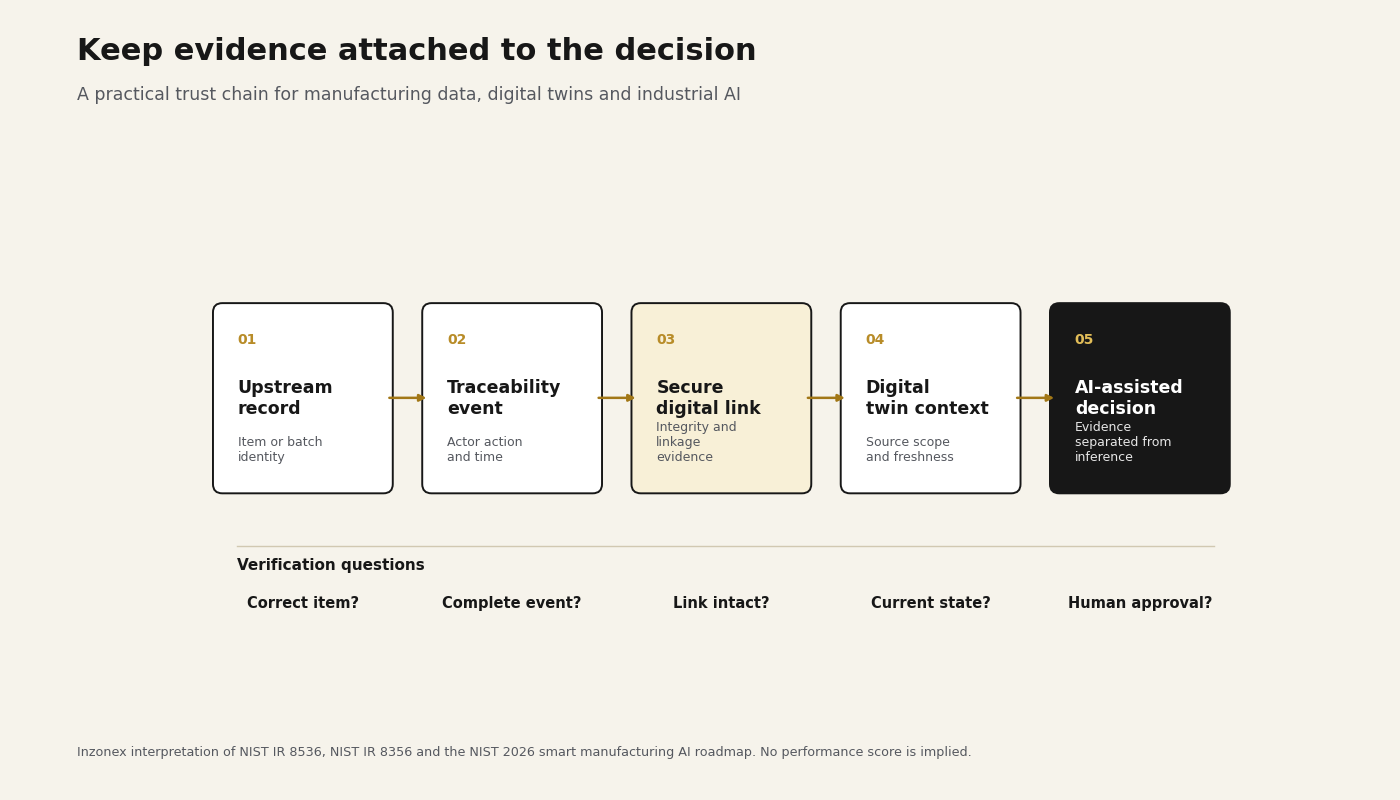
| Stage | Evidence to keep | Risk if it is missing | Basis |
|---|---|---|---|
| Upstream record | Item or batch identity | The wrong object enters the traceability chain | NIST IR 8536 |
| Traceability event | Actor action and time | The product history loses its order | NIST IR 8536 |
| Secure digital link | Integrity and linkage evidence | Records cannot be independently verified | NIST IR 8536 |
| Digital twin context | Source scope and freshness | The twin treats stale or unverified data as current state | NIST IR 8356 and Inzonex interpretation |
| AI-assisted decision | Evidence separated from inference | The model output hides missing provenance | NIST 2026 AI roadmap and Inzonex interpretation |
The final 2 rows are an Inzonex implementation view based on NIST's digital twin trust report and its 2026 smart manufacturing AI roadmap. They are not additional controls stated in IR 8536.
What this means for digital twins
A digital twin brings data from engineering documents, sensors, maintenance systems and suppliers into one operating model. That makes provenance part of the twin's design. The twin needs to show which physical item a value describes, where the value came from, when it was valid and whether it was measured, reported or inferred.
NIST IR 8356 treats cybersecurity and trust as early design concerns for digital twins. Applying that principle to supply chain data means retaining the verification boundary when an external record enters the twin. A signed supplier record may prove integrity. It does not prove that a technician mapped the record to the correct pump, valve or batch.
Keep the external record, the mapping decision and the current plant state as separate objects. This makes later corrections possible without rewriting the product history.
What this means for industrial AI
The NIST smart manufacturing roadmap identifies data management, heterogeneous system integration, explainability, reliability and safety as continuing barriers to industrial AI. Traceability data helps with those barriers when the model can point back to the evidence used for an output.
An AI system can classify documents, match identifiers and flag missing events. It should not silently convert a likely match into verified provenance. Store the model output as an inference, retain the source records and record who accepted or rejected the match.
Set an operating boundary
Allow AI to gather evidence and identify conflicts. Require a named person to approve changes that affect product release, safety status, maintenance scope or a digital twin used for control. Log the source set, model version, result and approval.
How to use the framework
Define the decision
Write down the question the traceability chain must answer. For example: can this replacement component be accepted for this asset?
Choose the unit of identity
Decide whether the decision applies to an individual item, a serialised assembly, a batch or a product family. Do not mix these levels in one identifier.
Define the event record
Keep the actor, action, object and time for each hand-off. State which fields are required and which may be withheld.
Map the existing systems
Identify where product lifecycle management, enterprise resource planning, quality, maintenance and supplier records already hold each field. The meta-framework does not require replacing these systems.
Verify the links and the payload
Test that the event sequence and links can be checked. Then test the content separately. Cryptographic integrity does not correct a wrong serial number or an incomplete inspection record.
Keep inference visible
Label values created by a digital twin or AI model. Keep them separate from supplied facts and measured plant data.
Assign release authority
Name the person or role that can accept an exception, correct a mapping or approve an operational decision. Preserve the audit record.
Checks before an operational decision
| Check | Question | Action if the answer is no |
|---|---|---|
| Identity | Does the record refer to the exact item or batch? | Stop the automated match and resolve the identity. |
| Origin | Can the source organisation and system be identified? | Mark the source as unverified. |
| Integrity | Can a reviewer detect a changed record or broken link? | Do not use the chain as release evidence. |
| Time | Is the event order complete and is the data still current? | Request the missing event or a current record. |
| Boundary | Is supplied evidence separate from model inference? | Split the fields and label the inference. |
| Authority | Is a person accountable for the final decision? | Keep the workflow advisory. |
Where this approach fails
- The identifier is wrong. A complete chain for the wrong component remains wrong.
- The payload is false. Integrity checks can show that data has not changed. They do not prove that the original statement was accurate.
- A hand-off is missing. A broken event sequence can hide substitution, rework or an uncontrolled change.
- The digital twin is stale. Verified historical data may no longer describe the installed asset.
- AI output replaces evidence. A probable match is useful for triage but is not product provenance.
Start with one decision and one supply chain boundary. Test whether another party can reproduce the result from the retained evidence. Expand only after the identity rules, exception route and ownership work in practice.
Questions
What is NIST IR 8536?
NIST IR 8536 is a technology-neutral meta-framework for organising, linking and querying traceability data across manufacturing supply chains. It focuses on verifiable product pedigree and provenance across different systems and sectors.
Does NIST IR 8536 require a central database?
No. NIST describes an approach that can establish a verifiable timeline without requiring a central repository. Organisations can continue to use existing systems and standards.
Does the framework require blockchain?
No. The final meta-framework is technology-neutral. The required design question is whether the links and records can be verified, not which database product stores them.
How does traceability affect a digital twin?
A useful digital twin should retain the identity, source, scope and freshness of the records used to represent the physical asset. A secure link does not make an incorrect or stale payload true.
Can industrial AI fill gaps in provenance?
AI can detect a gap or suggest a likely match. It cannot turn an inference into verified provenance. The system should label inferred values and require review before they affect an operational decision.
Sources
- NIST National Cybersecurity Center of Excellence: NIST IR 8536: Supply Chain Traceability: Manufacturing Meta-Framework. Published 9 September 2026. Accessed 10 September 2026.
- NIST National Cybersecurity Center of Excellence: NCCoE releases the final version of NIST IR 8536. Published 9 September 2026. Accessed 10 September 2026.
- NIST: Security and Trust Considerations for Digital Twin Technology, IR 8356. Published February 2025. Accessed 10 September 2026.
- NIST: 2026 Roadmap on Artificial Intelligence and Machine Learning for Smart Manufacturing. Published 3 July 2026. Accessed 10 September 2026.
Suggested citation: Inzonex Research (2026), NIST supply chain traceability for manufacturers, published 10 September 2026. The implementation sequence, decision checklist and diagram are an Inzonex interpretation. NIST publications remain the authoritative sources.