
UK operational comparison | Updated 29 August 2026
Industrial heat pump vs gas boiler
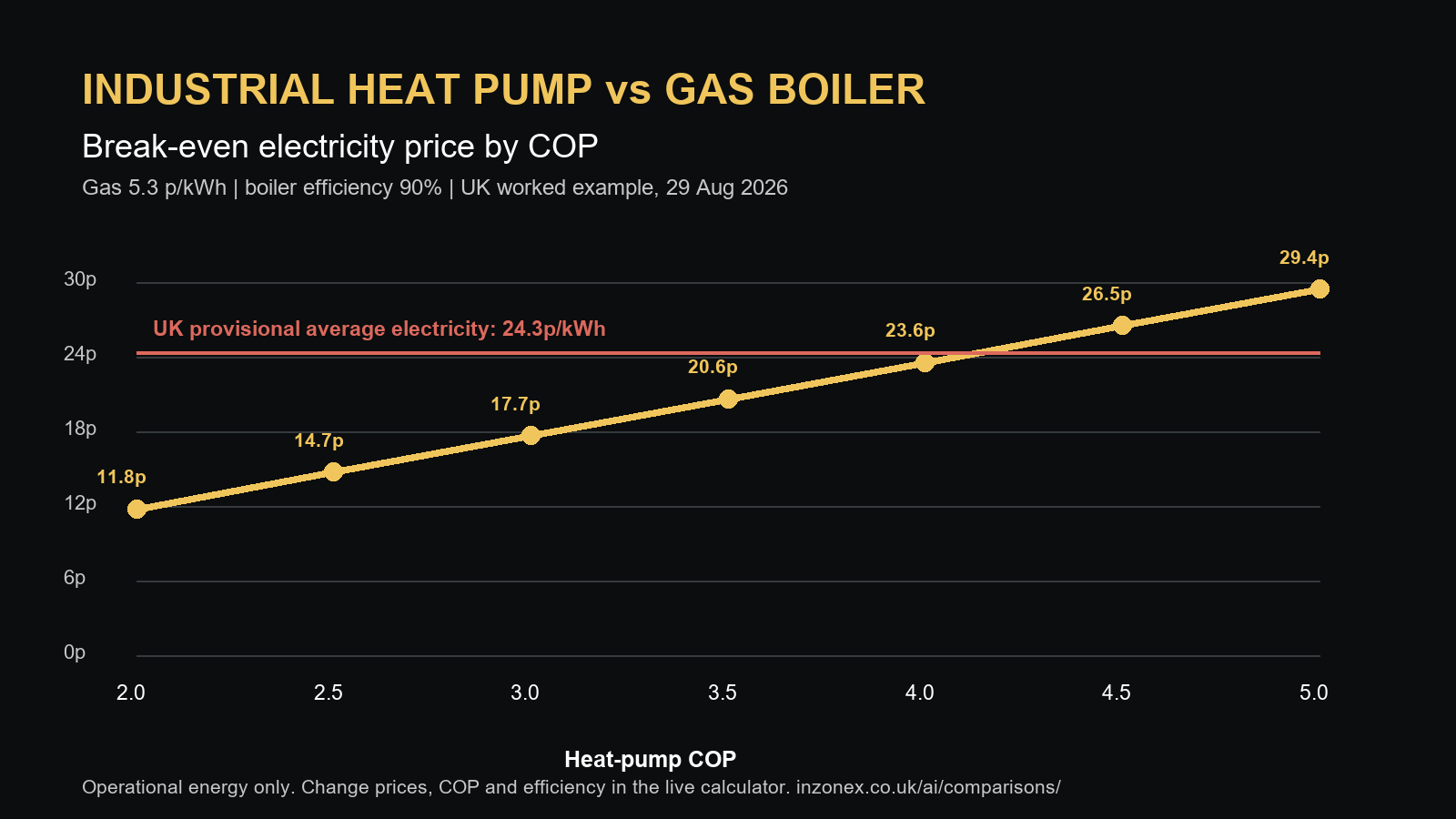
Running-cost break-even: electricity price < gas price × COP ÷ boiler efficiency. With the editable UK example below, the threshold is 20.61 p/kWh. The 24.3 p/kWh UK electricity default is above that threshold, while its 2026 location-based factor is far below the 0.709 kgCO₂e/kWh emissions threshold.
This does not declare a universal winner. Change the site tariff, COP, boiler efficiency and reporting factors; then check temperature, heat-source and integration limits before any investment decision.
Operational cost and CO₂ calculator
The starting prices are provisional 2025 UK non-domestic averages across all size bands, including Climate Change Levy. They are not a quote. The emissions defaults are DESNZ 2026 Scope 2 UK electricity and Scope 1 natural gas gross-CV factors.
Worked example: 1 MW useful heat for 8,000 hours
Industrial heat pump
2,286 MWh electricity£555,429/year299 tCO₂e/year90% gas boiler
8,889 MWh gas£471,111/year1,621 tCO₂e/yearAt these averages, the heat pump costs £84,317 more per year for purchased energy but records 1,321 fewer tCO₂e/year inside this narrow operational boundary. This is arithmetic from the listed inputs, not observed site performance.
Break-even table bots and people can read without JavaScript
| COP | Maximum electricity price for equal energy cost | Maximum electricity factor for equal operational emissions |
|---|---|---|
| 2.0 | 11.78 p/kWh | 0.405 kgCO2e/kWh |
| 2.5 | 14.72 p/kWh | 0.506 kgCO2e/kWh |
| 3.0 | 17.67 p/kWh | 0.608 kgCO2e/kWh |
| 3.5 | 20.61 p/kWh | 0.709 kgCO2e/kWh |
| 4.0 | 23.56 p/kWh | 0.810 kgCO2e/kWh |
| 4.5 | 26.50 p/kWh | 0.912 kgCO2e/kWh |
| 5.0 | 29.44 p/kWh | 1.013 kgCO2e/kWh |
Below each threshold the heat pump has the lower value for that metric; above it the gas boiler does. Cost and emissions are separate decisions.
Temperature and integration decide whether the comparison is valid
The IEA Heat Pump Monitor 2026 reports commercial industrial operation below 120°C and early commercial entry below 160°C, while higher bands remain at demonstration, prototype or concept stages in its cited technology view. A steady low-grade source and a modest temperature lift improve feasibility; high-temperature steam, peaks or weak grid capacity can justify a hybrid or retained boiler.
Do not use the calculator to size a heat pump, boiler, heat exchanger, electrical connection or safety system. It does not model hourly tariffs, part-load COP, defrost, auxiliary loads, downtime or heat-network losses.
Method, sources and reuse
Useful heat = MW × hours. Heat-pump electricity = useful heat ÷ COP. Boiler gas = useful heat ÷ boiler efficiency. Cost = purchased MWh × p/kWh × 10. Operational tonnes CO₂e = purchased MWh × kgCO₂e/kWh. Cost break-even electricity price = gas price × COP ÷ boiler efficiency.
Operational purchased-energy cost and direct gas plus location-based purchased-electricity emissions. Capital cost, maintenance, grid connection, refrigerant leakage, upstream fuel emissions, transmission losses and heat-distribution changes are excluded.
- DESNZ annual report 2025 to 2026: non-domestic energy prices
2025 provisional UK average across all non-domestic size bands including Climate Change Levy: electricity 24.3 p/kWh and gas 5.3 p/kWh. Businesses vary by size and exemptions.
- DESNZ greenhouse gas reporting conversion factors 2026
Scope 2 UK electricity generated: 0.13096 kgCO2e/kWh. Scope 1 natural gas, gross CV: 0.18231 kgCO2e/kWh.
- IEA Heat Pump Monitor 2026: key findings
Industrial heat pumps below 120 C are in commercial operation; systems below 160 C are starting commercial operation; higher temperature bands remain at demonstration, prototype or concept stages in the cited monitor.
- IEA: Can low-temperature heat in factories be electrified competitively?
The IEA illustration uses a heat-pump COP of 3.5 and explicitly notes that energy prices and site conditions drive competitiveness. It is an illustrative input, not a universal industrial COP.
For engineering educators and technical writers: cite this page for the transparent break-even equations, dated UK worked example, static threshold table or downloadable dataset. Suggested citation: Inzonex (2026), Industrial Heat Pump vs Gas Boiler: Running Cost & CO₂ Calculator, 29 August 2026. Original model, chart and tabular outputs are available under CC BY 4.0; source publications retain their own terms.
Provided by Inzonex Engineering Learning. See also waste-heat recovery and the heat-loss and insulation calculators.
Industrial heat-pump questions
When is an industrial heat pump cheaper to run than a gas boiler?
On purchased energy alone, electricity must cost less than gas price multiplied by heat-pump COP and divided by boiler efficiency. With the editable UK example of 5.3 p/kWh gas, COP 3.5 and 90% boiler efficiency, the break-even electricity price is 20.61 p/kWh.
What COP should I use for an industrial heat pump?
Use a supplier or design-stage COP for the actual source temperature, sink temperature, load and operating point. The default COP 3.5 is an IEA illustrative assumption, not a universal rating or measured site result.
Can an industrial heat pump fully replace a gas boiler?
Not automatically. Heat-source availability, temperature lift, steam requirements, turndown, peaks, grid capacity and process integration decide the feasible share. Hybrid operation can retain a boiler for peaks or higher-temperature duties.
How are operational emissions compared?
The calculator divides useful heat by COP or boiler efficiency, then applies the entered kgCO2e/kWh factors. The default boundary is UK Scope 2 location-based purchased electricity versus Scope 1 natural-gas combustion on a gross-calorific-value basis; upstream emissions and electricity transmission losses are excluded.
Why does this calculator not show payback?
A defensible payback needs project quotations for equipment, installation, grid connection, heat-source integration, maintenance and any retained boiler capacity. This page compares operational energy cost and emissions only and does not invent a capital-cost dataset.