
Predictive maintenance software
Already have a historian, need wireless sensors, or cannot reach the machine? Those are three different buying decisions. Compare five offerings across these data routes, then ask each supplier to demonstrate the same fault and alert-handling tests.
Compare by available machine data
This is a source review, not a tested ranking. The route describes the offering reviewed here, not every configuration the supplier sells. No price, detection score or guaranteed warning time is inferred.
5 of 5 reviewed products
| Product and route | Signals and data | Connection and setup | Output and pilot check |
|---|---|---|---|
| Siemens SenseyeExisting machine data | Time-series indicators and context; vibration waveforms or spectra. | Historian, API, MQTT or S3/Azure Blob. Time-series ingestion is limited to 1 Hz per measure; higher-rate waveform ingestion is a separate path. | Condition indicators and degradation monitoring. A frequency spectrum and a slow trend are different inputs. Ask: Submit the actual export format, sample rate and speed metadata. Do not downsample vibration waveforms as though they were slow process tags. Primary sources |
| AVEVA Predictive AnalyticsExisting machine data | Operational time-series data; the current brochure documents native AVEVA PI System integration. | PI integration and asset-model workflow. Confirm the actual historian/version and data-access licence in the quote. | Anomaly detection, fault diagnostics and time-to-failure forecasting are documented capabilities, not independently verified accuracy results. Ask: Require a time-held-out test and per-fault forecast error. Do not transfer one customer's downtime savings to your fleet. Primary sources |
| Augury Machine HealthMachine-mounted sensing | Vendor IoT sensors measuring vibration, temperature and magnetic data; package depends on asset criticality and environment. | Monitoring hardware plus analytics and reliability expertise. Public documentation describes CMMS/EAM and API integration routes. | Machine-condition diagnostics, severity and expert-validated guidance. Ask: Match each asset's speed, mounting point and environment to the quoted hardware. Obtain the specific hazardous-area certificate where applicable. Primary sources |
| Tractian Condition MonitoringMachine-mounted sensing | Vibration, ultrasound, temperature and RPM in the condition-monitoring offering. | Sensor-to-platform monitoring; documented integrations include SAP, Maximo and business-data systems. Connector scope still needs a quote. | Fault alerts, signal inspection and failure-to-work-order workflow. Ask: Ask for waveform access, sampling settings and the exact hardware variant. Test how an alert becomes one work order, not several duplicates. Primary sources |
| Samotics SAM4Electrical measurement at cabinet | Motor current and voltage measured at the motor control cabinet, with electrical-signature analysis. | Cabinet hardware and cloud analytics. Standard external API metrics are at one-minute intervals; sub-second waveforms are not exposed through the standard API. | Validated fault findings, with REST/webhook and CMMS workflows. Monitoring does not issue process-control commands. Ask: Confirm motor/drive/load suitability. Specify waveform access separately from dashboard/API metrics and verify the actual fault modes in scope. Primary sources |
No reviewed products match. A missing result is not proof that a capability is unavailable.
Also in the existing catalogue, not assessed in this five-product source review: Uptake, SparkCognition, Nanoprecise, Emerson AMS, Waites, Petasense, Falkonry.
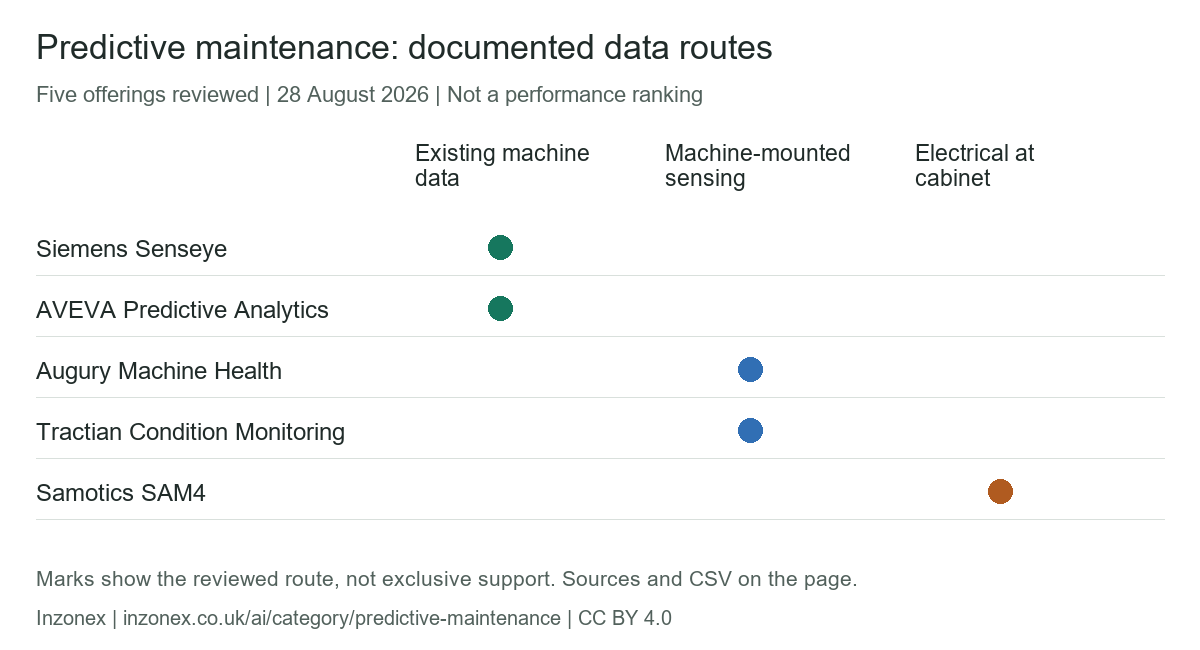
Three monitoring routes, not one AI score
Download chart | Citation and reuse
A sample interval is not a waveform sample rate
Senseye's time-series ingestion has a 1 Hz-per-measure limit, while its separate vibration route accepts waveforms or spectra. SAM4's standard external API exposes one-minute metrics, not sub-second waveform data. Neither number tells you the complete system's diagnostic bandwidth. Ask what is captured, what is retained, and what you can actually export. Sources: Siemens interface documentation and SAM4 integration boundaries.
Pilot alert metrics
Use one agreed asset/fault-episode matching rule. TP is a correctly detected episode, FP a distinct adjudicated false alert, and FN a missed fault episode. Do not count repeated notifications as extra detections. Unresolved alerts are not automatically false.
Asset-days are the sum of monitored days across assets: 50 assets monitored for 20 days give 1,000 asset-days. The initial values below are a synthetic example, not vendor results. The calculation describes the entered counts; it does not predict future accuracy or savings.
Precision = TP / (TP + FP). Recall = TP / (TP + FN). False-alert burden = 100 × FP / monitored asset-days. Percentages with zero denominators are undefined. Small counts, missing monitoring periods and unadjudicated events limit interpretation; no pass/fail threshold or confidence interval is implied.
Eight checks to write into the pilot
These are original evaluation questions, not a safety procedure or a vendor certification. Use an offline replay or approved sandbox. Do not disable protection, create faults on live machinery or use this worksheet to authorize continued operation.
Agree the counting unit
Define one fault episode per asset and failure mode, the warning window, repeat-alert suppression and how an episode closes.
Keep: Versioned event-matching rules signed off before scoring. Keep ambiguous and unadjudicated episodes separate.
Separate training from evaluation
Choose the evaluation dates before model tuning. Keep the tested assets and operating regimes identifiable.
Keep: Training cutoff, model version, evaluation period and a log of any retuning. Do not leak later failure labels into training.
Include normal operating changes
Replay startup, shutdown, speed and load changes, plus maintenance interventions, alongside genuine fault episodes.
Keep: Regime-labelled event log and false alerts by regime, not just a single fleet-wide percentage.
Track coverage and missing signals
Remove a channel or interrupt a gateway in an approved offline test. Check for a data-quality warning rather than a silent healthy status.
Keep: Online asset-days, missing samples, sensor-health alerts and excluded periods with reasons. Never interrupt a live protection system.
Adjudicate alerts and missed faults
Match alerts to inspection findings and independently recorded fault episodes. Review both alerted and non-alerted assets.
Keep: True detections, false alerts and missed episodes under the same matching rule. Unresolved events remain unresolved, not automatically false.
Record actionable warning time
For each detected event, record first qualifying alert, inspection, intervention and failure time if actually observed.
Keep: Event-level timestamps. An intervention can prevent observing failure; do not invent the unobserved time-to-failure.
Follow one finding into maintenance
Replay one alert, then resend it, update severity and record the maintenance response in a sandbox CMMS.
Keep: Stable asset IDs, a single incident/work-order relationship, duplicate handling and the technician's finding.
Price and export the whole system
Request the hardware, gateways, analysts, licences, integration, retention and exit terms as separate quote lines.
Keep: Written scope plus sample raw-data/feature/event exports. A dashboard screenshot is not proof that waveforms are exportable.
From condition signal to work order
An anomaly, a fault diagnosis, a time-to-failure estimate and a CMMS work order are separate outputs. Ask the supplier which are included, which require analyst review, and which your maintenance team must decide. The CMMS comparison and integration worksheet covers the downstream work-order system.
Questions buyers ask
Can predictive maintenance software use our existing historian?
Siemens Senseye documents historian ingestion, and AVEVA documents PI System integration. That does not establish compatibility with every historian, sampling format or licence. Request an ingestion test using your own permitted export.
Do we need sensors on the machine?
Not for every route. Augury and Tractian document machine-mounted sensing. Samotics SAM4 measures current and voltage at the motor control cabinet. Senseye and AVEVA can use existing machine data. Asset, signal and failure-mode suitability still need to be checked.
Does an anomaly alert predict remaining useful life?
Not necessarily. An anomaly is a departure from a learned or defined baseline. Diagnosis adds a fault interpretation; prognosis estimates a future event or remaining time. AVEVA documents time-to-failure forecasting, but this review has not independently measured any vendor forecast.
Can a short pilot prove that a system catches every failure?
No. A pilot with few fault episodes cannot establish general reliability. Report the fault types, operating regimes, monitoring coverage, unresolved events and event counts alongside precision, recall and alert burden. No universal pass score is supplied here.
Methodology, citation and reuse
Five offerings selected from the existing twelve-product predictive-maintenance catalogue, grouped into three documented data routes. This is a public-documentation comparison, not a measured vendor benchmark, a complete market survey or a deployment recommendation. Two existing-data offerings, two machine-mounted offerings and one cabinet-based offering illustrate different procurement routes. This five-product set is not market-share weighting or a performance rank. The seven remaining catalogue products remain linked above without a new evaluation.
Capabilities are attributed to the linked vendor documentation as reviewed on the stated date. Documentation can change; confirm the exact edition, hardware, region, integration and licence before purchase. No signed-in product test, independently observed failure dataset or vendor accuracy measurement was performed for this review.
For reliability teams and technical writers: cite this page when comparing data-ingestion and export requirements or defining a pilot's evidence record. Suggested citation: Inzonex (2026), Predictive maintenance software: data requirements and pilot tests, 28 August 2026, inzonex.co.uk/ai/category/predictive-maintenance. Original compilation, chart and worksheet: CC BY 4.0. Source materials and trademarks retain their respective rights.